
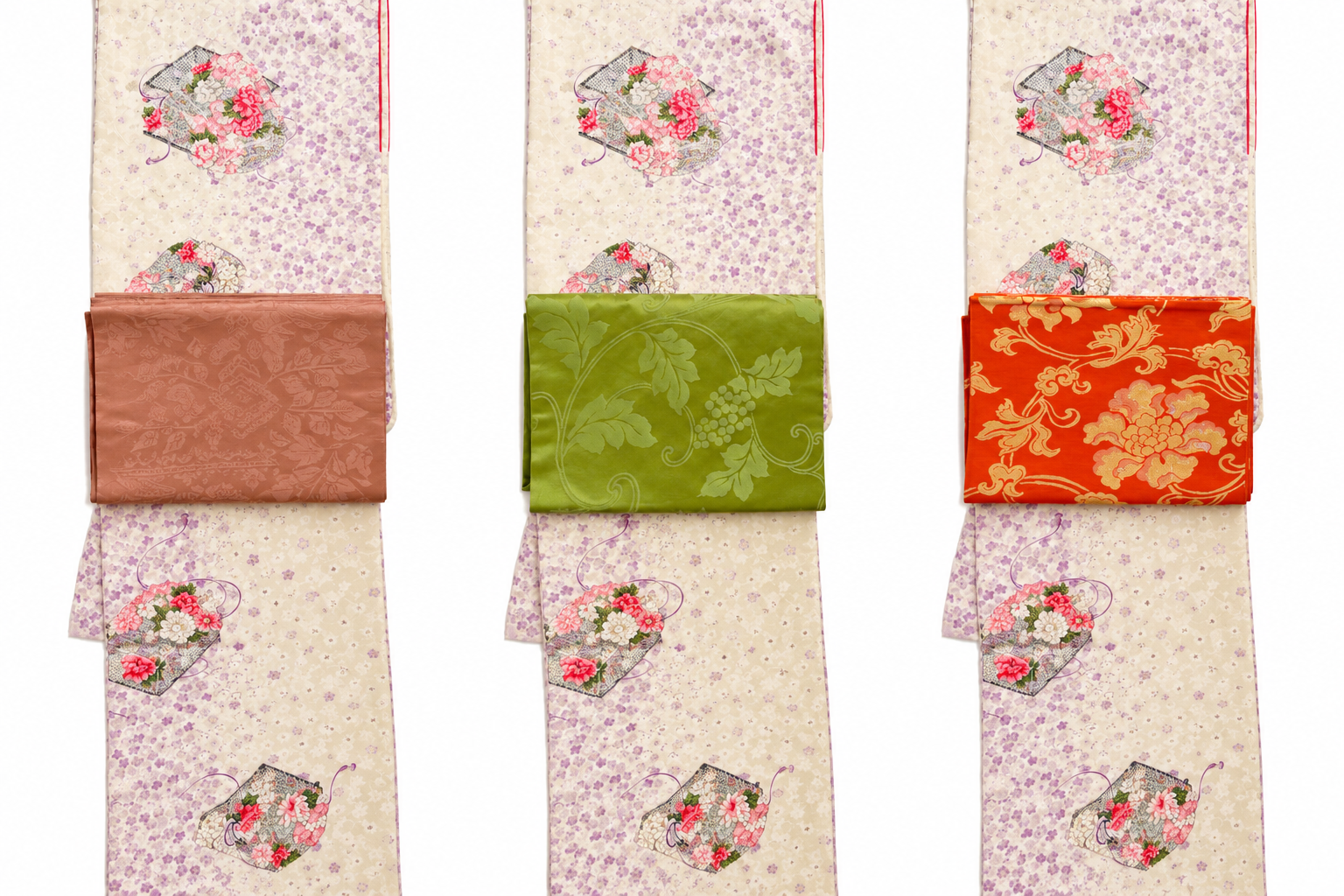
When I first decided to make kimono part of my everyday life, I started with an iromuji, a single-color kimono my mother had given me.
There was just one problem: she didn’t have an obi that suited it.
So I went to buy one.
At the time, I knew very little about choosing an obi. The shop assistant recommended a pale Hakata-ori obi, made using a traditional Japanese weaving technique. She explained that if I wanted to wear kimono regularly, it would be a versatile choice that I could pair with many different kimono.

And she was right.
I have worn that obi many times since, with different kimono and on different occasions.
But looking back, I wonder how I might approach that same visit today.
I still love that obi. Would I choose it again? Perhaps. Or perhaps I would choose something entirely different.
Even if I chose the same one, I would arrive at that decision differently.
Today, I would consider not only whether an obi suits the kimono, but also how it changes the overall look and whether the combination suits the occasion.
And that, to me, is part of the pleasure of choosing an obi.
In this article, we’ll explore the different types of obi, their formality, and the possibilities they bring to kimono styling.
In This Article
• Why Does the Obi Matter?
• Understanding the Five Main Types of Obi
— Maru Obi — Traditional Formal Splendor
— Fukuro Obi — From Formal Ceremonies to Elegant Outings
— Nagoya Obi — Practicality Meets Versatility
— Hanhaba Obi — Freedom in Casual Dressing
— Heko Obi — Softness and Movement
• How to Match Obi Formality with Kimono
— Does Gold or Silver Make an Obi Formal?
— Woven Obi and Dyed Obi
• Choosing Obi Colors and Patterns
• Does the Season Matter When Choosing an Obi?
• How Obi Tying Changes the Overall Look
— Ichijū-daiko — Single-Layered Taiko
— Nijū-daiko — Double-Layered Taiko
— Decorative Knots for Furisode
— Casual Knots with Hanhaba and Heko Obi
• Obi Length and Pattern Placement
— Does the Length Work for You?
— Where Will the Pattern Appear?
• What About Obiage and Obijime?
• Choosing an Obi with Intention
Why Does the Obi Matter?
Imagine the same kimono with two different obi.
With one, the outfit might feel quiet and refined. With the other, it could take on a bold, modern character.
The kimono hasn’t changed, yet the overall impression feels different.
This is one of the things I find fascinating about obi.
An obi helps secure and shape the dressed kimono, but it also plays an important aesthetic role. From the front, it adds color and texture to the outfit. From behind, the way it is tied becomes part of the silhouette.
But the wide, decorative obi we recognize today did not always exist.
In the seventeenth century, women’s obi were much narrower. During the Edo period (1603–1868), they gradually became wider and more elaborate as fashions and ways of dressing changed.
The kimono and obi evolved together, each influencing the overall appearance of the other.
So when choosing an obi, matching the colors is only one part of the decision.
I think three questions are particularly helpful:
The occasion: Where will you wear the kimono?
The formality: Does the obi suit the kimono and the occasion?
The styling: What kind of impression do you want to create?
These questions help us understand not only which obi might suit a kimono, but also why different combinations create different impressions.
And that understanding gives us more possibilities with the kimono and obi we already own.
Understanding the Five Main Types of Obi
There are many variations of obi worn with women’s kimono, but five types are especially useful to know: maru obi, fukuro obi, Nagoya obi, hanhaba obi, and heko obi.
Maru Obi — Traditional Formal Splendor
The maru obi was traditionally considered the most formal type of obi.
It is woven as a single piece of fabric approximately twice the finished obi width, then folded lengthwise and sewn. This allows the elaborate woven patterns to appear on both sides.
Often decorated with intricate designs and gold or silver threads, maru obi are beautiful but also heavy and difficult to tie.
Today, they are relatively uncommon and are mainly seen in traditional bridal wear and the clothing of maiko, apprentice geisha.

Fukuro Obi — From Formal Ceremonies to Elegant Outings
The fukuro obi became a lighter, more practical alternative to the maru obi and is now widely worn with formal and semi-formal kimono.
Unlike a maru obi, which uses richly patterned fabric on both sides, a fukuro obi usually has a decorative front and a simpler, often plain, back.
A typical fukuro obi is about 31–32 cm wide and 430–435 cm long. Longer versions are also available, especially for elaborate knots.
Its length allows it to be tied in a nijū-daiko, a double-layered taiko knot commonly worn for formal and celebratory occasions. With furisode, more decorative knots are also popular.
Depending on its design and the occasion, a fukuro obi may be paired with tomesode, furisode, hōmongi, tsukesage, or iromuji.
But not all fukuro obi are formal.
Some are richly woven with gold or silver threads and feature classical designs or auspicious motifs, making them well suited to formal ceremonies and celebrations.

Others, often called share-bukuro obi, feature more relaxed materials, colors, or patterns and can be paired with komon or tsumugi for less formal outings.
Nagoya Obi — Practicality Meets Versatility
The Nagoya obi has an interesting history, closely connected to the changing lives of women in early twentieth-century Japan.
One story of the Nagoya obi’s origins begins with Haruko Koshihara, who founded a girls’ school in Nagoya.
Busy with her work, she came up with a lighter, more practical obi that could be tied more quickly.
In 1924, Nakamura Gofukuten began selling the Nagoya obi, and it soon became popular across Japan.
Compared with many fukuro obi, Nagoya obi are generally shorter, often around 360–380 cm. They are commonly tied in an ichijū-daiko, a single-layered taiko knot.
Many have a narrower, pre-folded section for wrapping around the waist and a wider section for forming the taiko at the back. This makes them easier to handle, although other finishing styles also exist.

Nagoya obi are often paired with komon and tsumugi for everyday wear and casual outings.
However, their use is not limited to casual kimono. Depending on the material, weaving, and design, more refined Nagoya obi can also be worn with iromuji, tsukesage, or hōmongi for appropriate occasions.
Nagoya obi are also commonly divided into two types: kyūsun and hassun.
These names refer to the traditional kujirajaku measuring system, in which one sun is approximately 3.8 cm.
Kyūsun Nagoya Obi — Nine-Sun Nagoya Obi
A kyusun Nagoya obi is made from fabric approximately nine sun (about 34 cm) wide before finishing.
Its edges are usually folded inward, and an obi-shin (stiffening core) is added, producing a finished width of roughly 30–31 cm.
Kyusun Nagoya obi can feature patterns woven into the fabric or dyed onto it.
Some woven examples have refined classical motifs and gold or silver threads, making them suitable for dressier occasions.
Dyed Nagoya obi offer a wide variety of designs, from playful seasonal patterns to delicate hand-painted motifs, and are often enjoyed with less formal kimono.
Hassun Nagoya Obi — Eight-Sun Nagoya Obi
A hassun Nagoya obi is woven at approximately eight sun (about 30–31 cm) wide, close to its finished width.
Unlike a kyusun Nagoya obi, its edges do not need to be folded inward to reduce the width. It is also generally made without a separate obi core, as the fabric has enough structure of its own.
Common examples include Hakata-ori, tsumugi-type weaves, and tsuzure-ori (tapestry weaving).
Many hassun obi are well suited to everyday kimono, including komon, tsumugi, and cotton kimono.
However, some finely woven tsuzure-ori obi with formal designs and gold or silver threads can also be worn with more formal kimono, such as iromuji or tsukesage, depending on the occasion.
Although their names suggest different widths, finished kyusun and hassun Nagoya obi are often about the same width. The way they are constructed is a better clue to telling them apart.
Hanhaba Obi — Freedom in Casual Dressing
The word hanhaba means “half-width.”
While most women’s fukuro and Nagoya obi are around 30–32 cm wide, a hanhaba obi is typically about 15–17 cm wide.

It is particularly associated with yukata, but can also be worn with casual kimono such as cotton or wool kimono, komon, and tsumugi.
One of its greatest attractions is the variety of ways it can be tied.
Many of these knots can be tied without an obi pillow or the accessories normally used for taiko knots, making hanhaba obi particularly practical for everyday wear.
Hanhaba obi are commonly around 360–400 cm long, although lengths vary. Longer obi offer more possibilities for elaborate knots, while shorter ones can work well for simpler styles.
Some are also reversible, allowing different colors or patterns to appear depending on how the obi is wrapped and tied.
Even when made from luxurious fabrics or tied in elaborate ways, hanhaba obi are generally considered casual and are not the usual choice for formal ceremonies.
Heko Obi — Softness and Movement
The heko obi is a soft, flexible sash traditionally associated with men’s and children’s clothing.
Its name comes from heko, a word for young men in the Satsuma region (present-day Kagoshima), where this type of sash was once worn.
Today, heko obi are also popular with women, especially for yukata and casual kimono.

Unlike the more structured hanhaba obi, a heko obi is generally made from wide, flexible fabric without a stiff inner core.
Traditional examples include soft silk, sometimes decorated with shibori dyeing, while modern versions can also be made from cotton or synthetic fibers.
The fabric can be gathered, folded, or tied into soft, flowing shapes. Some create large, airy bows, while others hold more defined folds depending on the material.
This gives heko obi a relaxed appearance, with plenty of room for creative styling.
How to Match Obi Formality with Kimono
Choosing an obi is not only about finding colors and patterns that look beautiful together.
In traditional kimono dressing, the formality of the obi should also suit the kimono and the occasion.
For example, a formal fukuro obi may look striking with a casual cotton kimono, but it does not turn that kimono into ceremonial dress.
Likewise, a hanhaba obi does not become appropriate for a formal wedding simply because its colors match a hōmongi.
The following table offers a practical starting point.
| Kimono type | Common obi choices | Typical occasions |
|---|---|---|
| Furisode | Formal fukuro obi; maru obi in certain traditional styles | Coming-of-age celebrations, weddings |
| Kurotomesode / Irotomesode | Highly formal fukuro obi, often with gold or silver threads | Weddings and formal ceremonies |
| Hōmongi / Tsukesage | Formal or semi-formal fukuro obi; selected dressy Nagoya obi for less formal occasions | Weddings, receptions, social gatherings |
| Iromuji | Fukuro obi or Nagoya obi, depending on crests and occasion | Tea gatherings, ceremonies, outings |
| Komon | Nagoya obi, casual fukuro obi, or hanhaba obi | Dining, exhibitions, everyday outings |
| Tsumugi | Nagoya obi, casual fukuro obi, or hanhaba obi | Casual outings and everyday wear |
| Cotton or wool kimono | Hanhaba obi, casual Nagoya obi, or heko obi | Everyday wear and casual outings |
| Yukata | Hanhaba obi or heko obi | Summer festivals, casual summer outings |
These are general guidelines, not fixed combinations.
Some finely woven Nagoya obi can be worn with dressier kimono, while certain fukuro obi are designed specifically for casual styling.
The presence and number of family crests, the occasion, and the expectations of the setting also matter.
This is why I think it helps to distinguish between two questions:
What type of obi is it?
How formal is this particular obi?
The first tells us about its construction and general category. The second requires us to consider its material, weaving, design, and intended use.
If you would like to learn more about kimono types and their levels of formality, see Understanding Kimono Formality.
Does Gold or Silver Make an Obi Formal?
Gold and silver threads are commonly found in formal obi, especially those worn for weddings and celebrations.
But their presence alone does not determine formality.
A richly woven obi featuring classical auspicious motifs may be suitable for formal ceremonies. Another obi might incorporate a touch of gold or silver into a playful or modern design while remaining intended for casual wear.
When judging an obi’s formality, we need to consider its weaving, materials, patterns, and overall design—not just whether it contains metallic threads.
Woven Obi and Dyed Obi
You may come across a familiar guideline when coordinating kimono and obi:
A woven obi with a dyed kimono.
A dyed obi with a woven kimono.
Here, woven and dyed refer to how the designs are created—woven into the fabric or applied through dyeing.
This saying reflects not only differences in texture, but also traditional ideas about formality.
For example, a formal hōmongi is often paired with a richly woven obi, while a casual tsumugi may be paired with a dyed Nagoya obi.
But these are not fixed rules.
A dyed komon can also be paired with a dyed obi, and a tsumugi with a casual woven obi. Both combinations are commonly enjoyed in everyday kimono styling.
Choosing Obi Colors and Patterns
Once the obi suits the kimono and the occasion, we can explore one of the most enjoyable parts of kimono dressing: combining colors and patterns to create the impression we want.
There are several ways to approach this.
Matching Similar Colors
Choosing an obi in the same color family as the kimono can create a calm, harmonious appearance.
For example, a pale blue kimono paired with a deeper blue obi can feel elegant and unified.

Differences in shade, texture, or pattern can add depth without introducing a contrasting color.
Picking Up a Color from the Kimono Pattern
This is one of the easiest approaches for beginners.
Imagine a kimono decorated with small flowers in cream, pink, and green.
Choosing an obi that echoes the pink or green can create a natural connection between the two textiles.
The obi does not have to match the kimono’s main background color. Sometimes, a color hidden in a small detail of the pattern offers a more interesting possibility.

Creating Contrast
Choosing a contrasting obi can give the outfit a stronger visual impact.
For example, a dark obi against a light-colored kimono can bring definition to the overall look.

Combining warm and cool colors may create a bolder, more expressive impression.
But contrast does not always have to be dramatic. Even subtle differences in brightness or tone can change the balance of an outfit.
Combining Patterns
Does a patterned kimono always need a plain obi?
Not necessarily.
Combining patterns is another enjoyable part of kimono styling.
One approach is to consider the scale and density of the designs.
For example, a kimono covered with small, repeated flowers may pair beautifully with an obi featuring one large, bold motif.
A densely patterned kimono can also work well with an obi that has more open space around its design.
Even two richly patterned textiles can work together, especially when they share colors or have different pattern scales.
There is no single formula. The important thing is to look at how the two designs work together rather than judging each one separately.
One Kimono, Different Obi
If you have several obi that suit the same kimono, try laying each one over the kimono before deciding.
Compare their colors, textures, and patterns. Does one draw attention to a particular motif? Does another soften a bold pattern or create a stronger contrast?

You may discover that an obi you hadn’t considered before brings out a beauty in the kimono you had barely noticed.
Does the Season Matter When Choosing an Obi?
Like kimono, obi can express the seasons through their fabrics, colors, and patterns.
Summer obi, for example, may feature airy weaves such as ro, sha, or ra, while seasonal motifs can evoke a particular time of year.
But when choosing an obi, we also need to consider how its seasonal characteristics work with the kimono itself.
A sheer ro obi, for example, is generally not paired with a lined awase kimono in winter. Their fabrics belong to very different seasonal styles.
However, the transition between seasons allows more flexibility.
In late spring, a lighter obi may be introduced before changing to a summer kimono. Similarly, an unlined hitoe kimono may be worn with a summer obi in early autumn, before gradually returning to non-summer obi as the season changes.
The timing can vary depending on the climate, the occasion, and the traditions being followed.
When coordinating kimono and obi, it helps to consider their fabrics and textures together, rather than treating each piece separately.
For more about seasonal fabrics, motifs, and the traditions behind them, see Kimono and the Seasons: Awase, Hitoe & Seasonal Motifs.
How Obi Tying Changes the Overall Look
The way an obi is tied can change its appearance considerably.
Some knots create neat, compact shapes, while others use folds and bows to add volume and movement.
The finished shape becomes part of the overall kimono styling.
Ichijū-daiko — Single-Layered Taiko
The ichijū-daiko is a traditional obi knot with a single-layered taiko, the folded section of the obi visible at the back.

It is commonly tied with a Nagoya obi and is often seen with everyday kimono such as komon and tsumugi. Depending on the obi, it can also be worn for dressier occasions.
Its simple, structured shape provides a beautiful way to display the obi’s woven or dyed patterns.
Nijū-daiko — Double-Layered Taiko
The nijū-daiko has two layers in the folded taiko at the back.
It is commonly tied with a fukuro obi and is widely worn with formal and semi-formal kimono, such as tomesode and hōmongi.

The overlapping layers are traditionally associated with the wish for happiness and celebrations to be repeated, making this knot particularly meaningful for festive occasions.
Decorative Knots for Furisode
Furisode are often paired with elaborate decorative obi knots.
The fukura-suzume creates rounded, wing-like shapes, while the tateya forms a large, diagonally arranged bow.
These knots add volume and movement to the back of the outfit, complementing the festive appearance of furisode.

Casual Knots with Hanhaba and Heko Obi
Hanhaba obi can be tied in various ways, from the bow-like bunko-musubi to the more compact kai-no-kuchi.

Heko obi offer other possibilities, with their soft fabrics creating flowing folds and voluminous bows.
These different shapes can make an outfit feel playful, relaxed, or contemporary.
The way an obi is tied can also change which parts of its pattern are visible.
Obi Length and Pattern Placement
Even when an obi suits your kimono in style and formality, its length and pattern placement can affect how it looks when worn.
Does the Length Work for You?
Obi vary in length, and vintage examples can be considerably shorter than modern ones.
The length needed depends on your body measurements and how you intend to tie the obi. A length suitable for a simple taiko knot may not be enough for a more elaborate arrangement.
Where Will the Pattern Appear?
Not every obi has patterns along its entire length.
There are three common arrangements:
Zentsū-gara — All-Over Pattern
The design extends along essentially the entire length of the obi.
Rokutsū-gara — Six-Tenths Pattern
The pattern covers approximately six-tenths of the obi, leaving areas that are normally hidden when tied less decorated.
Otaiko-gara — Placed Pattern
The motifs are positioned to appear in particular places, especially at the front of the body and on the taiko at the back.
With an otaiko-gara obi, the placement of the motifs is especially important.

Maru obi traditionally feature all-over patterns, while fukuro obi and Nagoya obi can have any of these three pattern arrangements.
Depending on your body measurements and the way the obi is tied, a motif may appear in a slightly different position than expected.
Understanding these arrangements helps you consider not only how an obi looks when laid flat, but also how its design will appear when worn.
What About Obiage and Obijime?
The obi is not the only element that contributes to the coordination.
With traditional taiko knots, two additional accessories are usually visible: the obiage and obijime.
The obiage is a piece of fabric seen above the obi. It covers and helps secure the obimakura, a small cushion used to support the taiko shape.
The obijime is a decorative cord tied around the obi that also helps keep the finished knot securely in place.
Both add color and texture to the outfit.

A subtle change in the color of an obiage or obijime can create a different impression, even when the kimono and obi remain the same.
Casual knots tied with hanhaba or heko obi often do not require these accessories. When they are used, their formality and seasonal characteristics should also be considered.
Choosing an Obi with Intention
An obi does not have to be the boldest or the most elaborate to be the right choice.
But a beautiful combination is not only about how the two textiles look together. The occasion, the setting, and the people around us also matter.
Understanding the different types of obi, their formality, and their designs helps us make these choices with greater care and creativity.
Sometimes the most versatile obi is exactly what we need. At other times, a different choice may bring out something special in a particular kimono.
I still treasure the pale Hakata-ori obi I bought when I first began wearing kimono. It was a wonderful choice then, and it remains one today.
What has changed is how I look at the possibilities.
For me, the pleasure of choosing an obi is not simply finding one that matches, but discovering what the kimono and obi can bring out in each other.
Sources
- Nishijin Textile Industrial Association — Types of Obi. Traditional obi classifications, construction, and common uses. (In Japanese)
- Nishijin Textile Industrial Association — Obi Sizes. Obi dimensions and considerations for fit and tying. (In Japanese)
- The Metropolitan Museum of Art — Beauty of the Kanbun Era. A seventeenth-century painting illustrating the narrower obi worn during the Kanbun period.
- The Metropolitan Museum of Art — Wedding Obi (Sash). The construction, craftsmanship, and ceremonial significance of the formal maru obi.
- Nagoya City Library — The Origins of the Nagoya Obi. Historical research on Haruko Koshihara and the development of the Nagoya obi. (In Japanese)
- Kyoto National Museum — Sash (Maru Obi) with Butterflies and Composite Flowers. A historical example of a Nishijin-woven maru obi from the Taishō period.

Leave a Reply