
When you hear the word “kimono,” what comes to mind?
Perhaps you picture a geisha or maiko with white makeup and an elaborate hairstyle. Perhaps you imagine a bride in a richly decorated wedding kimono, or a young woman wearing a colorful furisode.
When I offered kimono experiences in Japan, I discovered that some guests arrived with exactly these images in mind. A few expected the experience to include white makeup, a traditional hairstyle, and the distinctive dress they associated with geisha or maiko.
Geisha and maiko are part of a specialized professional world of traditional performing arts, with its own distinctive makeup, hairstyles, and dress.
The experience I wanted to offer was different.
I wanted international guests to enjoy kimono as someone in Japan might on a special day out—meeting friends, strolling through a neighborhood, or visiting a cultural site. For this reason, I mainly dressed guests in casual kimono and refined styles suited to outings.

Kimono, however, includes many different garments, ranging from highly ceremonial bridal attire to refined outing wear and relaxed summer yukata. A kimono chosen for a wedding is not the same as one worn for a meal, a tea gathering, a walk through town, or a summer festival.
This article introduces the foundation of kimono formality: the different levels of dress, the elements that shape them, and the role of context in understanding what may suit a particular occasion.
In This Article
・Kimono Has Its Own Levels of Formality
・The Kimono Type Is Only the Starting Point
・Four Broad Levels of Kimono Formality
— A Simple Kimono Formality Chart
・Formal Kimono
・Semi-Formal Kimono
・Smart Informal Kimono
・Casual Kimono
・What Determines the Formality of a Kimono?
— Family Crests
— Pattern Placement
— Dyed and Woven Textiles
— The Obi and Accessories
・Comparing Kimono Formality with Western Dress Codes
・Dressing for the Moment
Kimono Has Its Own Levels of Formality
Kimono has its own system of formality, shaped by Japanese history and social customs. At first, this system can appear complicated.
As I have studied the history and traditions of kimono, however, one perspective has become especially important to me. I believe that the most important question in choosing kimono is not only whether the garment is appropriate, but how the wearer’s appearance can bring out the fullest value of the occasion—its beauty, dignity, meaning, and the relationships among the people present.
Seen this way, formality is not simply about choosing the “correct” garment. It is also a way of considering how what we wear can contribute to the character and meaning of the moment.
The Kimono Type Is Only the Starting Point
In Japanese, the word kimono is written with two characters: 着, meaning “to wear,” and 物, meaning “thing.” Its basic meaning is therefore simply “something to wear,” or clothing.
Today, however, kimono generally refers to a broad category of traditional Japanese garments.
As mentioned above, this broad category includes many different types of garments. Some of the names you will encounter in this series are furisode, homongi, komon, and yukata. Distinguishing these types gives us one useful way to see how kimono formality works.
The type of kimono alone does not determine the formality of the complete outfit. Crests, pattern placement, fabric, obi, accessories, the occasion, and the wearer’s role all work together to shape the formality of the complete outfit.
This article focuses primarily on women’s kimono. Men’s kimono follow their own conventions of formality and are outside the scope of this article.
Four Broad Levels of Kimono Formality
To make kimono formality easier to understand, it is helpful to think of it in four broad levels. These are not strict categories, but a simple guide for beginners.
Just keep in mind that customs may vary depending on the event, family tradition, region, or school of practice.
A Simple Kimono Formality Chart
| Level | Representative kimono | Typical occasions |
|---|---|---|
| Formal | Shiromuku, iro-uchikake, hikifurisode, kurotomesode, five-crested irotomesode, furisode, formal mourning kimono | Weddings, coming-of-age ceremonies, major family ceremonies, funerals |
| Semi-formal | Homongi, tsukesage, crested iromuji, crested Edo komon | Wedding receptions, formal parties, ceremonies, prestigious gatherings |
| Smart informal | Uncrested iromuji, fine komon, and some Edo komon | Restaurants, exhibitions, informal parties, social gatherings |
| Casual | Komon, tsumugi, cotton kimono, wool kimono, yukata | Shopping, casual meals, travel, festivals, relaxed outings |
This chart is only a general guide. The formality of a particular kimono may shift depending on its crests, pattern placement, obi, accessories, the occasion, and the wearer’s role.
Formal Kimono
Formal kimono are worn for important ceremonial occasions.
Bridal garments such as shiromuku, iro-uchikake, and hikifurisode belong to this group. They are worn by brides during traditional Japanese weddings.

Kurotomesode is traditionally considered the most formal kimono for a married woman. It has a black ground, traditionally bears five family crests, and features decorative motifs around the lower part of the garment. Today, it is most often worn by the mothers and close married female relatives of the couple.
Irotomesode follows a similar design structure but has a ground color other than black. Its level of formality depends partly on the number of crests it carries, and it may be worn by both married and unmarried women.
Furisode, recognized by its long sleeves, is traditionally regarded as the most formal kimono for an unmarried woman. It is strongly associated with coming-of-age celebrations and may also be worn by an unmarried wedding guest.
Formal black mourning kimono also belongs to the highest level of ceremonial dress, although it serves an entirely different purpose from celebratory clothing.
These garments are not interchangeable simply because they are formal. Their suitability depends on the occasion and the wearer’s role within it.
Semi-Formal Kimono
Semi-formal kimono are worn for important occasions that do not require the highest level of ceremonial dress.
Homongi often features a pictorial design that flows across the seams, creating a coordinated composition over the garment. It may be worn by both married and unmarried women at wedding receptions, formal parties, celebrations, and ceremonies.

Tsukesage generally has a more restrained arrangement of motifs. Its level of formality and the occasions for which it is suitable depend on the design, crests, obi, accessories, and overall coordination.
Iromuji is dyed in a single color other than black, without a prominent pictorial design. It may still have a subtle woven ground pattern. A family crest can raise its formality, making it suitable for tea gatherings, ceremonies, and other refined occasions.
Certain traditional Edo komon patterns may also be worn at a semi-formal level, particularly when the kimono carries a family crest and is coordinated with an appropriate obi.
Smart Informal Kimono
The boundary between semi-formal and smart informal kimono is not always clearly defined.
An uncrested iromuji, an elegant komon, or a refined Edo komon may be suitable for a restaurant meal, exhibition, cultural gathering, theater visit, or small party.

These kimono create a polished and considered appearance while remaining less ceremonial than garments worn for highly formal occasions.
Casual Kimono
Casual kimono are worn for everyday enjoyment and relaxed outings.
Komon usually features repeated motifs across the garment. Depending on the fabric, design, and overall coordination, it may range from relaxed everyday wear to an elegant smart-casual outfit.

Tsumugi kimono are made from woven silk textiles and are traditionally associated with informal wear. Even a valuable and beautifully crafted tsumugi is generally not chosen for highly ceremonial occasions.
Cotton and wool kimono are also suitable for everyday wear, travel, and seasonal outings.
Yukata is one of the most casual forms of traditional Japanese dress. It is commonly worn at summer festivals, fireworks displays, hot-spring inns, and relaxed warm-weather gatherings.
What Determines the Formality of a Kimono?
The type of kimono is important, but it does not determine formality on its own. Throughout this article, we have already touched on several other factors. Let us now bring them together into four key elements: family crests, pattern placement, dyed and woven textiles, and the obi and accessories.
1. Family Crests
Family crests are called kamon, or simply mon, in Japanese.
A kimono may have five crests, three crests, one crest, or no crest.
Five crests are placed in five positions: one at the upper center of the back, one on each side of the chest, and one on the back of each sleeve. Three crests are placed on the back and sleeves, while a single crest is placed at the upper center of the back.

In general, a greater number of crests indicates a higher level of formality. Five crests are traditionally used on garments such as kurotomesode and formal black mourning kimono. A single crest can raise the formality of an iromuji or certain Edo komon.
Crests can raise the level of formality, but their effect depends on the type of kimono on which they appear.
2. Pattern Placement
Pattern placement is another important element in the formality of a kimono. What matters is not simply how much decoration a kimono has, but where the motifs are placed and how they are arranged across the garment.
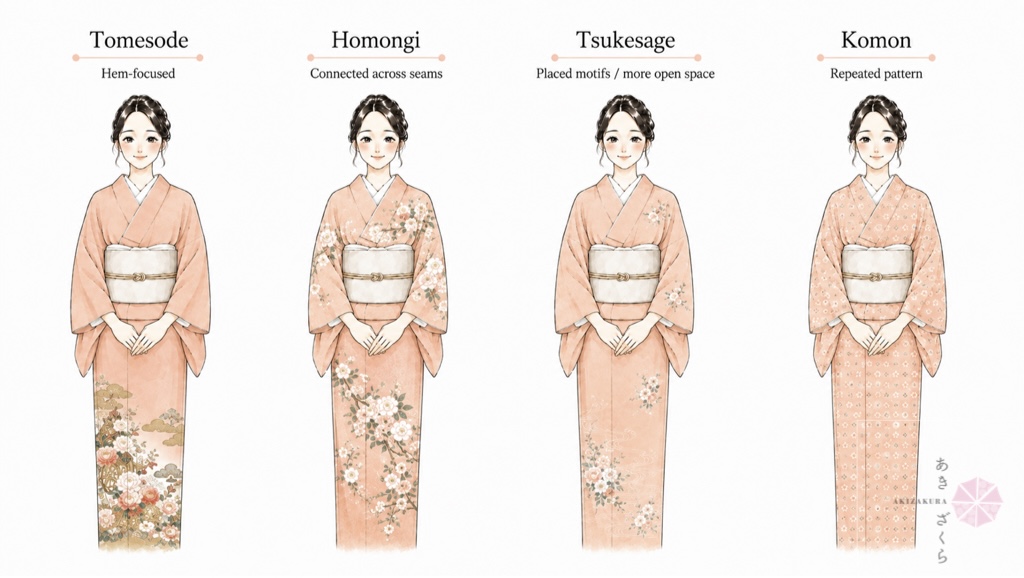
– On a tomesode, decoration is generally concentrated around the hem.
– On a homongi, the design crosses the seams and forms a connected composition across the garment.
– On a tsukesage, the motifs are generally arranged more sparingly and do not usually form the same continuous composition as those on a homongi.
– On a komon, motifs repeat across the surface rather than forming one connected pictorial composition.

Within the same category of kimono, the scale, richness, and density of the design may affect how festive or subdued the garment appears, and therefore the occasions for which it is most suitable. However, a greater amount of decoration does not automatically make a kimono more formal.
Pattern placement is therefore not merely decorative. It is one of the elements that shape the character and formality of a kimono.
3. Dyed and Woven Textiles
The way a textile is made is another element that contributes to the formality of a kimono. A traditional guideline generally places dyed kimono on the more formal side and woven kimono on the more casual side.
Tomesode, furisode, homongi, and iromuji are generally dyed garments and are worn for a range of formal and semi-formal occasions. By contrast, tsumugi is woven and is traditionally associated with informal wear.
Yuki-tsumugi offers a particularly clear example of how cultural and monetary value do not necessarily correspond to formal rank. Its traditional production technique is recognized by UNESCO as Intangible Cultural Heritage, and authentic Yuki-tsumugi kimono are often highly prized and can command very high prices. Yet, within the traditional hierarchy of kimono formality, they remain woven tsumugi and are not considered ceremonial dress.

4. The Obi and Accessories
The obi and accessories are also important elements in the formality of the complete kimono outfit. A kimono is not worn in isolation: the obi, obiage, obijime, collar, footwear, bag, and other details all contribute to its overall level of formality and character.
A furisode is normally paired with a formal fukuro obi and festive accessories. A komon may be coordinated with a nagoya obi or a more casual hanhaba obi, depending on the character of the outfit. A yukata is usually worn with a simpler obi and geta.

The choice of obi and accessories can make an outfit appear more formal, refined, relaxed, or casual. However, these elements work within the basic category of the kimono; they cannot transform an informal garment into formal ceremonial dress.
Comparing Kimono Formality with Western Dress Codes
There is no exact one-to-one correspondence between Japanese and Western dress codes. Broadly speaking, the most ceremonial kimono may be compared with bridal or white-tie attire in degree of formality. Formal and semi-formal kimono are closer to formal evening wear, suits, or cocktail dresses, while the kimono described here as smart informal or casual correspond more loosely to elegant daywear and relaxed everyday clothing.
These comparisons are intended only as a helpful guide to the general degree of formality. Each tradition has its own history, meaning, and social role, but looking at them side by side can make the structure of kimono formality easier to understand.
Dressing for the Moment
After looking at the different levels of kimono formality and the elements that shape them, the system may still seem complex. But formality is not simply a ranking of which kimono is more beautiful or valuable, nor is it a list of rules to follow for their own sake.
A useful place to begin is with two questions:
What is the occasion?
What is the wearer’s role within it?
These questions help put the other elements—kimono type, crests, pattern placement, fabric, obi, and accessories—into context. The most formal garment is not automatically the most appropriate one, and the same type of kimono may serve differently depending on who is wearing it and for what purpose.
For me, the point of kimono formality is not simply to avoid being out of place. It is to consider what our clothing can contribute to the occasion and to the people who share it.
This is the perspective we will carry through the rest of the series, as we look more closely at how different kimono express different roles, relationships, and ways of participating in both ceremonial and everyday moments.
Continue the Series
Next: Part 2 — Japanese Wedding Kimono
In Part 2, we will look more closely at Japanese wedding kimono, including the different garments worn by the bride, mothers, and other female relatives, and how clothing helps make their roles and the celebration itself visible.
Read Part 2: Japanese Wedding Kimono: A Guide to Bridal and Family Attire →
Or Explore Another Part of the Series
Part 3: What Is a Furisode? Long Sleeves, Coming of Age, and the Meaning Behind Japan’s Formal Kimono
Part 4: Homongi vs. Tsukesage vs. Iromuji: How to Tell the Difference and When to Wear Each
Part 5: Casual Kimono vs. Yukata: Understanding Komon and How the Two Differ
Part 6: Kimono in Modern Japan and Beyond: How It Is Worn, Chosen, and Adapted Today
Experience Kimono in Paris
Curious to experience kimono for yourself?
Choose from more than 200 authentic Japanese kimono and yukata and discover how it feels to wear kimono in contemporary life, here in Paris.
→ Learn more about the Kimono Experience in Paris
Sources
- Kyoto Kogei Sensho Cooperative Association. “キモノの格づけ” (Kimono Formality Rankings) and “キモノのTPOとコーディネート” (Kimono TPO and Coordination), in the Kyoto Yuzen Encyclopedia. These Japanese-language guides explain the relative formality, pattern placement, and typical occasions for furisode, kurotomesode, irotomesode, hōmongi, tsukesage, iromuji, komon, tsumugi, mourning kimono, and yukata, together with suitable obi, accessories, and footwear.
- Kyoto Kogei Sensho Cooperative Association. “紋の付け方と種類” (Family Crests: Types, Number, and Placement), in the Kyoto Yuzen Encyclopedia. This Japanese-language guide explains different types of crests, how one, three, and five crests affect formality, and where they are placed on a kimono.
- The Education Program for the Cultural Folklore and for the Transmission of “Kimono” Culture. This educational resource provides an English-language introduction to kimono construction and TPO, with examples including furisode, kurotomesode, irotomesode, tea gatherings, theatre visits, weddings, and mourning attire.
- Agency for Cultural Affairs, Government of Japan. “令和5年度 生活文化調査研究事業(和装)報告書” (FY2023 Research Report on Japanese Dress Culture). This official Japanese-language report examines the historical development, present practice, and transmission of Japanese dress culture.
- UNESCO. “Yuki-tsumugi, Silk Fabric Production Technique.” This official entry explains the traditional spinning, dyeing, and weaving techniques of Yuki-tsumugi and its inscription on the Representative List of the Intangible Cultural Heritage of Humanity.

Leave a Reply