
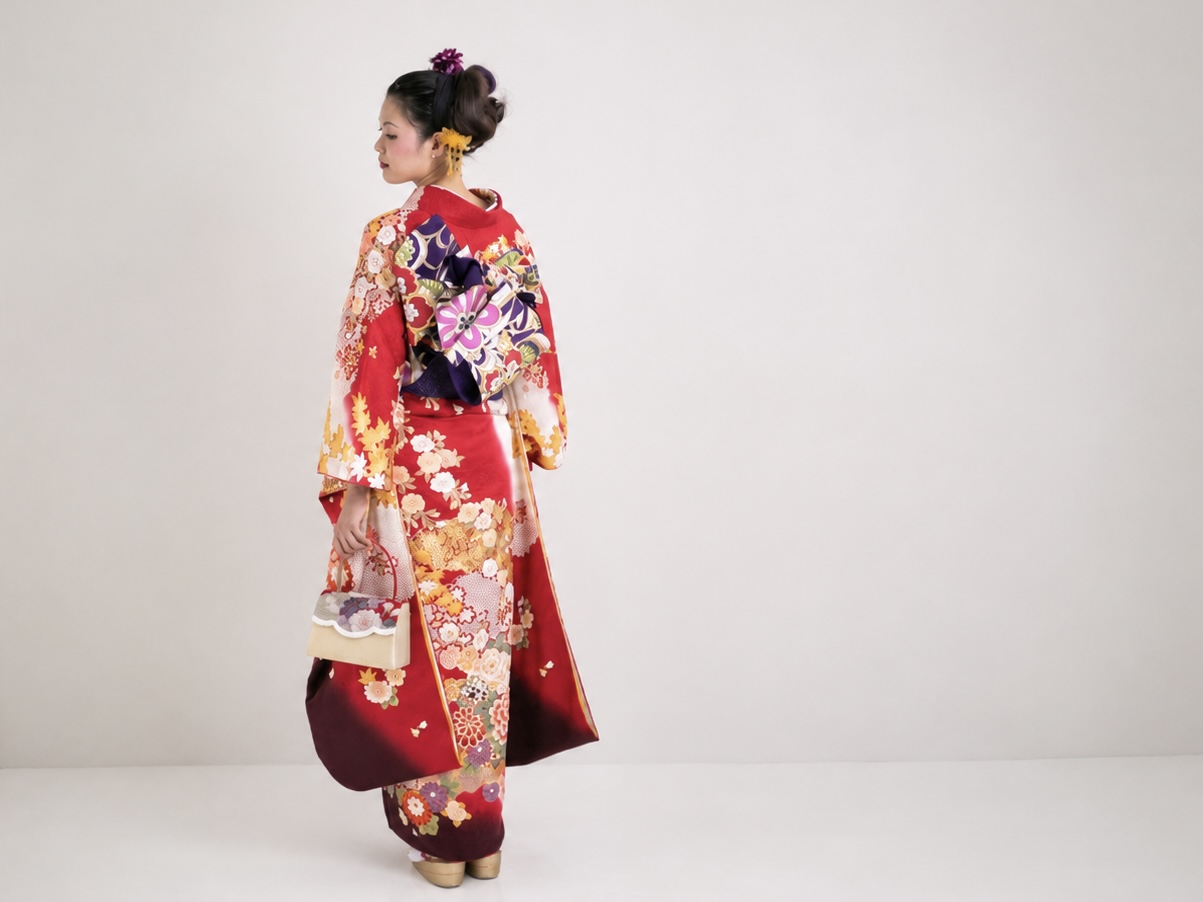
In the earlier articles in this series, we explored how kimono formality reflects the occasion, the wearer’s role, and the relationships surrounding a ceremony. We also saw how wedding kimono can give visible form to celebration, hospitality, and good wishes.
Furisode expresses these ideas in its own distinctive way. Its long sleeves and expansive designs create a striking silhouette, but its meaning extends beyond visual beauty. Historically associated with unmarried women, it is worn for coming-of-age celebrations, weddings, graduations, and other important formal occasions.
Although furisode is worn by one woman, the occasion surrounding it is often shared with others. The garment can become part of a family’s celebration and memory.
In this article, we will explore how furisode developed, how its long sleeves came to be associated with young, unmarried women, and how its colors, motifs, movement, and the care surrounding it continue to shape its meaning today.
In This Article
・What Is a Furisode?
— A Brief History of Furisode
— Why Is Furisode Traditionally Worn by Unmarried Women?
— Different Sleeve Lengths
— Why Are the Sleeves So Long?
— Stories and Feelings Carried by Sleeves
・Furisode and Coming-of-Age Celebrations
・Other Occasions for Furisode
— Weddings
— Furisode and Hikifurisode
— Graduation Ceremonies
・The Furisode Ensemble
— Colors, Motifs, and Composition in Furisode
— The Obi and the Back View
— The Long Sleeves in Motion
・A Celebration Worn by One, Shared by Many
What Is a Furisode?
The name furisode combines the ideas of “swinging” and “sleeve.” Its defining feature is its exceptionally long sleeves, which hang beside the body and move visibly with the wearer.
In contemporary kimono etiquette, furisode is traditionally regarded as the most formal kimono for an unmarried woman. It may be worn for coming-of-age celebrations, as formal guest attire at weddings, and on other important celebratory or ceremonial occasions.

Formal furisode are often richly decorated. Many feature an eba-moyō composition, in which motifs continue across the seams so that the garment appears as one unified design.
Flowers, birds, flowing water, fans, courtly objects, geometric forms, and other auspicious motifs may be combined within a single composition. Many carry seasonal references or wishes for happiness, longevity, prosperity, and good fortune.
A Brief History of Furisode
Both the form and the meaning of furisode have changed over time.
In earlier dress customs, furisode was associated with clothing worn before adulthood by both boys and girls. In a custom known as sodetome, the open areas around the sleeves were altered and the long sleeves were shortened as the wearer entered adult life. The name tomesode is connected with this practice, although the modern formal kimono known as tomesode, which we introduced in Part 2 of this series, developed much later.
As clothing customs changed, sleeve length gradually became the clearest visible difference between furisode and shorter-sleeved adult kimono. During the Edo period, the long-sleeved form became increasingly associated with young, unmarried women.
Over time, furisode became established as formal and celebratory dress for unmarried women.
The furisode we see today is therefore the result of many generations of change. Its form and social role evolved as ideas about age, marriage, fashion, and formal dress changed with society.
Why Is Furisode Traditionally Worn by Unmarried Women?
Furisode is often summarized as:
The most formal kimono traditionally worn by an unmarried woman.
This association grew from earlier clothing customs in which sleeve length helped make the wearer’s stage of life visible. As furisode became closely associated with young, unmarried women, it also became established as their formal and celebratory dress.
Under traditional kimono etiquette, a married woman would no longer wear furisode for formal occasions. Instead, she would choose another kimono suited to her role and the occasion. This might include tomesode, hōmongi, or iromuji, although hōmongi and iromuji may also be worn by unmarried women.
Today, furisode may be enjoyed more flexibly outside formal ceremonial settings. At weddings and other occasions shaped by traditional kimono etiquette, however, its association with unmarried women remains meaningful.
Different Sleeve Lengths
Modern kimono guides often group furisode into three broad categories according to sleeve length. The precise boundaries vary by source, period, the wearer’s height, and the individual garment, so these names are best understood as general guides rather than fixed measurements.
Ō-Furisode
Ō-furisode has the longest sleeves and creates the most dramatic silhouette. It is traditionally regarded as the most formal of the three categories.
Chū-Furisode
Chū-furisode falls within the middle range and is often associated with coming-of-age celebrations and formal guest attire at weddings. In modern practice, however, the boundary between chū-furisode and ō-furisode is not always fixed.
Ko-Furisode
Ko-furisode has shorter sleeves and allows greater ease of movement. It is commonly paired with hakama for graduation ceremonies.

Why Are the Sleeves So Long?
There is no single simple explanation for why furisode sleeves became so long.
As clothing customs changed, the sleeves of furisode gradually became longer, and their flowing form became increasingly associated with young women’s formal dress.
Whatever first shaped this development, the long sleeves became one of the most distinctive features of furisode.
They offer a generous space for textile design, allowing flowers, birds, flowing water, and other motifs to unfold across the fabric with rhythm and depth.
Stories and Feelings Carried by Sleeves
In Japanese poetry, songs, and folk traditions, the gesture of moving or waving sleeves has often been associated with affection, longing, and emotional expression. Over time, sleeves also came to carry other symbolic meanings.
This sensitivity to sleeves is not limited to furisode. It also remains in Japanese expressions: sode o nurasu, “to wet one’s sleeves,” means to shed tears, while sode o hiku, “to pull someone’s sleeve,” can mean to call, invite, or gently prompt someone.
These expressions remind us that sleeves have long been connected not only with clothing, but also with human feelings and relationships. Seen within this wider cultural background, the movement of furisode sleeves can feel even more expressive.
Furisode and Coming-of-Age Celebrations
Japan has long had ceremonies marking the passage into adulthood. The civic coming-of-age ceremonies familiar today developed after the Second World War, and furisode gradually became one of their most recognizable forms of dress.
Coming of Age Day, or Seijin no Hi, is observed on the second Monday of January, and in most parts of Japan, local coming-of-age ceremonies are held in January, often on or around the national holiday. Japan’s legal age of adulthood was lowered from 20 to 18 in 2022, but many municipalities continue to hold ceremonies for those reaching the age of 20.

A smaller number of municipalities, including some in Nagano and Iwate, hold their ceremonies in summer, often around the Obon holiday. The reasons vary by region, but summer ceremonies can avoid severe winter weather and make it easier for young people who have moved away for study or work to return home.
When the ceremony is held in summer, some women attend in lighter clothing and wear furisode on a separate day for a portrait session. Separate formal portrait sessions are now common across Japan, allowing families to preserve a formal image of the wearer in furisode even when the garment is not worn at the ceremony itself.
Preparing for the Day
For many young women, the experience begins long before the ceremony.
A woman may:
- Choose or reserve her furisode
- Coordinate the obi and accessories
- Plan her hairstyle
- Have the fit and measurements checked
- Take formal photographs in advance
Some families purchase a new furisode. Others rent one or prepare a garment inherited from the wearer’s mother, grandmother, or another relative.
The preparation can become part of the celebration itself, creating family memories before the day even arrives.
A Garment That Marks the Day
Furisode can make a coming-of-age milestone feel distinct from ordinary life. Its colors, patterns, and long sleeves give visible form to the importance of the occasion and help preserve it as a memory.
For parents and grandparents, seeing a daughter or granddaughter in furisode—and standing beside her in a family photograph—can make the years of her growth suddenly visible. When a furisode is passed down, a daughter or granddaughter may one day wear the same garment her mother or grandmother once wore, allowing family memories to continue across generations. Whether the furisode is inherited, purchased, or rented, the care taken to prepare the ensemble can become part of the family’s joy.
When I moved to France in 2025, among the belongings my parents made sure I took with me were commemorative photographs from important stages of my life, including Shichi-Go-San and my coming of age. I am from Nagano, and my local coming-of-age ceremony was held in summer, so I did not wear furisode to the ceremony itself. Instead, I had a formal portrait taken on a separate day, although I had almost no memory of the photo session until I saw the photograph again.

The furisode was probably rented, but the obi was one I had liked at a kimono shop and my mother had bought for me. I still have it today, and it has traveled with me from Japan to France.
Looking at the photograph and the obi now, I can feel the care my parents took to preserve the memories of these stages of my life. I may not have understood the meaning of those moments at the time, but the photographs and the obi carried something of that care forward, allowing me to recognize it many years later.
Other Occasions for Furisode
Although coming-of-age celebrations are the occasion most closely associated with furisode today, it may also be worn for weddings, graduation ceremonies, formal parties, and other celebratory occasions, depending on the wearer’s role and the formality of the event.
Weddings
At a wedding, an unmarried sister, relative, or close friend may wear furisode as formal guest attire. Its color and movement can add to the celebratory atmosphere, while the ensemble gives visible form to the guest’s congratulations.
The way it is worn also makes the wearer’s role clear. A guest’s furisode is dressed at a practical walking length with accessories appropriate to formal guest attire, rather than with the trailing hem and bridal styling used for hikifurisode.
Furisode and Hikifurisode
Furisode should not be confused with hikifurisode, the bridal garment introduced in Part 2.
| Furisode | Hikifurisode |
|---|---|
| Formal kimono traditionally worn by an unmarried woman | Formal bridal kimono |
| Worn for coming-of-age celebrations, as wedding guest attire, and on other formal occasions | Worn by the bride |
| Hem is dressed at a practical walking length | Hem is dressed to trail along the floor |
| Formal guest or celebratory attire | Bridal attire |
| Long sleeves create movement | Long sleeves and a trailing hem create a distinctive bridal silhouette |
The distinction lies not simply in the fact that both garments have long sleeves, but in the wearer’s role, the treatment of the hem, the silhouette, and the dressing method.

Graduation Ceremonies
At graduation ceremonies, ko-furisode is commonly paired with hakama, although kimono with standard-length sleeves and longer furisode are also worn.

The combination recalls the hakama style once adopted by female students in the Meiji period and has become closely associated with graduation. The hakama creates a structured lower silhouette while allowing the sleeves and upper-body design of the kimono to remain visible.
The Furisode Ensemble
The furisode itself is only one part of the complete appearance. It is coordinated with visible collar layers, an obi, obiage, obijime, tabi, zōri, a bag, and hair ornaments to create one formal ensemble.
Colors, Motifs, and Composition in Furisode
Furisode offers an enormous variety of color and textile design. It is not defined by a single palette: the ground color, motifs, obi, and accessories work together to create an impression that may feel bright, soft, dignified, playful, or dramatic.
Many of the auspicious motifs seen on furisode also appear in wedding kimono. Cranes, pine, bamboo, plum, fans, shippō, tortoiseshell patterns, courtly carriages, clouds, and flowing water were introduced in Part 2 of this series, where we explored their traditional associations in greater detail.
One of the qualities that gives furisode its distinctive presence is the way motifs are arranged across the garment. Large flowers, birds, fans, flowing water, and geometric forms may extend across the body and long sleeves, creating a composition that unfolds across the fabric.
Cherry blossoms, chrysanthemums, peonies, wisteria, butterflies, and many other motifs are also frequently seen. Their colors, scale, and placement may reflect the wearer’s taste, the fashion of the period, and the mood intended for the occasion.
Many furisode bring flowers from several seasons into a single composition. Rather than depicting a literal landscape, such designs often create an idealized and celebratory world filled with beauty, abundance, and good wishes.
Textile Techniques and Light
A single furisode may bring together several textile techniques. Yūzen dyeing, shibori, embroidery, woven ground patterns, and embellishment with gold or silver leaf and thread may all contribute to its depth and brilliance.
The effect comes not only from the motifs themselves, but also from the way color, texture, and light interact across the long sleeves and main panels.
The Obi and the Back View
The long sleeves and expansive patterns attract attention from the front, but the back view is equally important.

Today, furisode is commonly paired with a formal fukuro obi tied in a decorative musubi and coordinated with the surrounding accessories as part of the complete ensemble.
The obi does more than complete the dressing. Its color, pattern, and volume create a second visual center and balance the visual weight of the long sleeves. From the back, the decorative musubi becomes a focal point of the entire silhouette.
Seen from the front and the back, the ensemble reveals two related but different compositions.
The Long Sleeves in Motion
When the wearer stands still, the long sleeves of furisode fall vertically beside the body, emphasizing their length and creating a calm, formal silhouette.
As she begins to walk, turn, or raise her hands, however, the sleeves take on a different character. They swing gently, move away from the body, and reveal different parts of the design. A flower or bird that is partly concealed while the wearer stands still may come more fully into view as the sleeve moves.
The sleeves also change the outline of the wearer. From one angle, they form long vertical lines; from another, they spread outward or curve softly through the air. Their movement adds rhythm and depth to the garment, allowing its colors and motifs to be seen in changing relationships.

The visual effect does not come from the length of the sleeves alone. As the wearer becomes aware of their weight and fall, her movements can help the fabric flow more naturally and allow the design to be seen more beautifully.
The design of a furisode is therefore not fixed. It reveals itself differently in stillness and in motion.
A Celebration Worn by One, Shared by Many
Among formal kimono, furisode occupies a distinctive place. Its exceptionally long sleeves, expansive designs, and elaborate coordination create a striking presence. Its traditional association with unmarried women also links it closely to a particular stage of life.
Because furisode is often worn for coming-of-age celebrations, weddings, and other important occasions, its preparation and memory often extend beyond the wearer herself. Parents or grandparents may help make the occasion possible, and their care becomes part of the appearance that is finally seen.
At a coming-of-age celebration, furisode can make the wearer’s growth visible to those who have watched over her. At a wedding, it can express her congratulations to the couple while also bringing joy to her own family. In both cases, the garment is worn by one woman, but the feelings surrounding it may belong to more than one person.
Seen in this context, kimono formality does more than distinguish one level of dress from another. It can also make roles, relationships, and the meaning of an occasion visible. Furisode gives visible form not only to the wearer’s place at that moment, but also to the care, pride, and celebration shared by those around her.
Its long sleeves frame a single wearer, yet the celebration surrounding them is rarely hers alone.
Continue the Series
Next: Part 4 — Homongi vs. Tsukesage vs. Iromuji
In Part 4, we will look more closely at homongi, tsukesage, and iromuji—three kimono whose differences can be subtle at first glance. We will explore how pattern placement, open space, color, and crests create different kinds of presence, and how each may suit a different occasion.
Read Part 4: Homongi vs. Tsukesage vs. Iromuji: How to Tell the Difference and When to Wear Each →
Or Explore Another Part of the Series
Part 1: Understanding Kimono Formality: A Beginner’s Guide to Choosing the Right Kimono
Part 2: Japanese Wedding Kimono: A Guide to Bridal and Family Attire
Part 5: Casual Kimono vs. Yukata: Understanding Komon and How the Two Differ
Part 6: Kimono in Modern Japan and Beyond: How It Is Worn, Chosen, and Adapted Today
Sources
- Nihombashi Mitsukoshi. “Types of Kimono.” [Japanese]
https://www.mistore.jp/store/nihombashi/shops/kimono/kimono/kimono_techo/types.html - Marusho Yokohama. “An Introduction to Furisode: What It Is and When It Is Worn.” [Japanese]
https://www.hareginomarusho.co.jp/contents/furisode/177/ - National Diet Library. “Coming of Age Among Commoners: Sodetome.” [Japanese]
https://www.ndl.go.jp/kaleido/entry/31/3.html - Collaborative Reference Database, National Diet Library. “When Did Modern Coming-of-Age Ceremonies Begin, and When Did Women Begin Wearing Furisode for Them?” [Japanese]
https://crd.ndl.go.jp/reference/entry/index.php?fi=2_0+8_33&id=1000155100&ldtl=1&page=ref_view - Cabinet Office, Government of Japan. “National Holidays in Japan.” [Japanese]
https://www8.cao.go.jp/chosei/shukujitsu/gaiyou.html - Ministry of Justice, Japan. “Amendment of the Civil Code Concerning the Age of Majority.” [Japanese]
https://www.moj.go.jp/MINJI/minji07_00218.html - Government of Japan. “Q&A on the Civil Code Amendment Concerning the Age of Majority.” [Japanese]
https://www.gov-online.go.jp/assets/moj_minpo_seinen_nenrei_kaisei.pdf - Komagane City. “Coming-of-Age Celebration Held on August 15.” [Japanese]
https://www.city.komagane.nagano.jp/soshikiichiran/shakaikyoikuka/shogaigakushugakari/1/4/8594.html - Japan Center for Asian Historical Records. “How Did Women’s Fashion Change Before and After the War?”
https://www.jacar.go.jp/english/exhibition/glossary_en/tochikiko-henten/qa/qa02.html - Kotobank. “Sode o Nurasu — To Wet One’s Sleeves.” [Japanese]
https://kotobank.jp/word/%E8%A2%96%E3%82%92%E6%BF%A1%E3%82%89%E3%81%99-2057363 - Kotobank. “Sode o Hiku — To Pull Someone’s Sleeve.” [Japanese]
https://kotobank.jp/word/%E8%A2%96%E3%82%92%E5%BC%95%E3%81%8F-554728

About the Author
Sayoko is the founder of AKIZAKURA, a kimono stylist from Japan now based in Paris. Through AKIZAKURA Journal, she explores the history and practices surrounding kimono, while considering how it can continue to live in the present.
Leave a Reply