
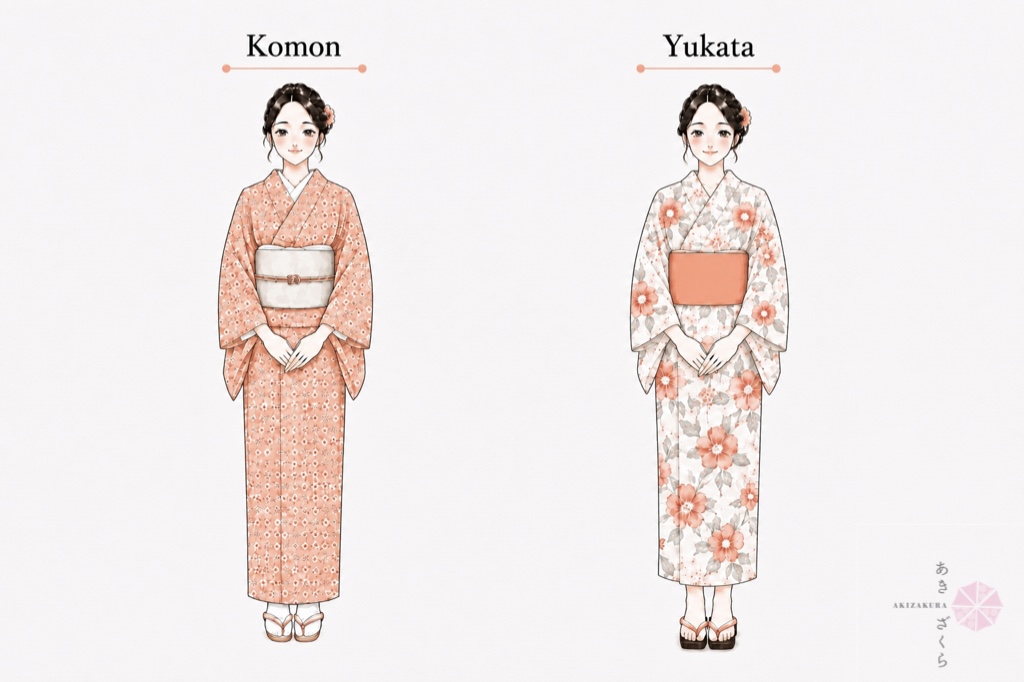
In the earlier articles in this series, we explored how kimono formality reflects the occasion, the wearer’s role, and the relationships surrounding it. We also saw how different garments can shape the meaning and atmosphere of a moment.
Casual kimono and yukata bring us to the more relaxed side of Japanese dress. Here, komon serves as the main example of casual kimono. Both may be worn for informal occasions, but they differ in their patterns, construction, dressing conventions, and use.
Their informality does not make them less meaningful. Formal kimono gives visible form to life’s major occasions, while komon and yukata can bring color, comfort, a sense of season, and personal expression into ordinary days. Since a life is made not only of milestones but also of ordinary days, enriching those days can enrich life as a whole.
In this article, we will explore how komon and yukata differ and how each brings traditional dress into everyday life.
In This Article
・A Quick Comparison
・Understanding Komon
— What Is a Komon?
— How Komon Differs from Homongi and Tsukesage
— Different Expressions of Komon
— Edo Komon — An Important Exception
— Is Edo Komon Formal or Casual?
— When Is Komon Worn?
— How the Obi Changes a Komon
— Choosing for an Ordinary Day
・Understanding Yukata
— What Is a Yukata?
— From Bathing Garment to Summer Fashion
— Ryokan Yukata and Festival Yukata
— Ryokan Yukata
— Festival or Outing Yukata
— Is Yukata Simply a “Summer Kimono”?
— Casual Does Not Mean Less Craftsmanship
— Can Yukata Be Styled Like Kimono?
・How to Tell Komon and Yukata Apart
— Consider the Complete Outfit
・A Life Made of Ordinary Days
・What Komon and Yukata Bring to a Day
A Quick Comparison
| Komon | Yukata | |
|---|---|---|
| Main characteristic | A kimono with repeated dyed motifs arranged across the garment | A very casual, unlined garment traditionally worn without a nagajuban |
| Common materials | Often silk; also cotton, wool, and synthetic fibers | Usually cotton or cotton blends; hemp or hemp blends may also be used |
| Season | Varies according to the textile and construction | Mainly associated with summer; ryokan yukata may be worn year-round |
| Undergarment | Normally worn over a nagajuban | Usually worn without a nagajuban, over light undergarments |
| Collar | A separate haneri is usually visible | Usually only the yukata’s own collar is visible |
| Footwear | Usually tabi with zori; geta may also be worn in casual coordination | Usually bare feet with geta; tabi may be added in some styles |
| Obi | Nagoya obi, hanhaba obi, or another informal obi | Usually a hanhaba obi or heko obi |
| Occasions | Meals, shopping, exhibitions, theatre, lessons, and social outings | Festivals, fireworks, summer outings, ryokan stays, and relaxation |
| General formality | Casual to smart informal | Very casual |
These are general conventions rather than absolute rules. Fabric, construction, styling, and the occasion can create exceptions, so the complete garment and coordination should be considered together.

A nagajuban is a robe-like undergarment worn over underwear and beneath the outer kimono. Its collar is covered with a detachable haneri, which remains visible at the neckline.
Understanding Komon
What Is a Komon?
Komon is a dyed kimono characterized by motifs that repeat across the fabric.
The motifs may include flowers, plants, animals, geometric forms, seasonal imagery, traditional objects, or abstract shapes. They are generally dyed onto the bolt before tailoring, so the design is not planned as one continuous picture across the seams.
Unlike homongi, komon does not usually form one coordinated pictorial composition across the garment. Unlike tsukesage, its motifs are not generally positioned for specific areas of the finished kimono.

Does Komon Always Mean a Tiny Pattern?
No. Although the name originally referred to small-patterned designs, modern komon is not limited to tiny motifs.
What defines komon more clearly is the repeated arrangement of its dyed motifs across the fabric, not their literal size.
How Komon Differs from Homongi and Tsukesage
| Homongi | Tsukesage | Komon | |
|---|---|---|---|
| Pattern arrangement | Often forms one coordinated pictorial composition | Motifs are placed in selected areas and generally face upward | Repeated motifs are arranged across the garment |
| Across the seams | Designs often continue across several seams | Motifs are usually more separate, although some may cross selected seams | The repeated pattern is not planned to form a continuous picture across the seams |
| General formality | Generally semi-formal | Semi-formal to smart informal | Mainly casual to smart informal |
A floral motif alone does not identify the category. What matters more is how the motifs are arranged across the garment.

This comparison refers mainly to ordinary komon. Certain crested Edo komon may be treated as semi-formal, as we will see later in this article.
Different Expressions of Komon
The repeated patterns of komon can create very different visual effects depending on their scale, spacing, color, and subject.
Fine and Subtle Patterns
A komon with closely repeated motifs may appear calm and refined. Depending on the color and density of the design, the obi can become a stronger visual focus.
Large and Bold Patterns
Other komon feature large-scale flowers, birds, geometric forms, or unusual and playful objects. Their bolder visual rhythm can express more personality and create a lively or dramatic impression.
Seasonal Patterns
Seasonal motifs are one way komon can bring a sense of the changing seasons into informal outings.
Plum blossoms can suggest late winter to early spring, cherry blossoms spring, morning glories summer, and maple leaves autumn. A realistic, season-specific motif may be worn shortly before or during the season it evokes.

Traditionally, wearing a seasonal motif slightly in advance has often been appreciated as a refined way of anticipating the season.
Stylized motifs, auspicious designs, and patterns combining flowers from several seasons may offer a wider wearing period.
Edo Komon — An Important Exception
Edo komon deserves separate attention because its formality can vary more widely than that of ordinary komon.
It is known for extremely fine stencil-dyed patterns, often worked in a single color. From a distance, many examples appear almost solid; close up, minute dots, lines, or shapes become visible.
Its development became closely connected with the fine patterns used on samurai kamishimo, a form of formal dress. During the Edo period, komon spread beyond the warrior class and developed a wider range of motifs among townspeople.
Is Edo Komon Formal or Casual?
The answer depends on the pattern, crest, obi, and occasion.
Among the most highly regarded traditional patterns are the three known as the Edo komon sanyaku:
- Same — tiny dots arranged in overlapping curves, creating a sharkskin-like effect
- Gyogi — dots arranged in neat diagonal rows
- Kakudoshi — tiny square forms aligned vertically and horizontally

A one-crested Edo komon in one of these classic patterns may be paired with an appropriate obi for semi-formal occasions. However, adding a crest does not automatically make every Edo komon suitable for semi-formal wear; the pattern, obi, and occasion must still be considered together.
Without a crest, the same classic-patterned Edo komon is generally worn at a less formal level. Edo komon with more playful or pictorial motifs is usually treated as refined informal wear, even when the craftsmanship is highly sophisticated.
When Is Komon Worn?
A typical komon may suit:
- Casual lunches or dinners with friends
- Shopping
- Theatre, concerts, and other performances
- Museums and exhibitions
- Cultural lessons
- Informal seasonal gatherings
- Travel
- Casual parties
- Town walks
Ordinary komon—unlike certain crested Edo komon—is generally not appropriate for formal weddings, ceremonies, or events requiring formal dress.
How the Obi Changes a Komon
The obi can adjust the mood and level of polish within the informal range. An appropriate Nagoya obi often creates a more polished coordination, while a hanhaba obi usually gives the ensemble a lighter, more relaxed character.
Both types vary in material, technique, and design, so the obi should be chosen as part of an ensemble that suits the occasion.
Choosing for an Ordinary Day
Komon leaves room to respond to the day itself. A seasonal motif, a playful design chosen for meeting a friend, or an obi selected for a particular destination can make the act of dressing feel more thoughtful and personal.
Such choices can bring color and a sense of season not only to the wearer’s day, but also to the setting and to the time shared with others.
Understanding Yukata
What Is a Yukata?
Yukata is an unlined, lightweight form of traditional Japanese dress, usually made from cotton or a cotton-blend fabric.
It is worn by people of all ages and genders and is closely associated with:
- Summer festivals
- Fireworks displays
- Bon dances
- Summer outings
- Traditional inns and hot-spring towns
- Relaxation after bathing
Yukata patterns may be seasonal, geometric, traditional, or contemporary. Pattern alone, however, does not identify a garment as yukata.
A typical yukata is worn without a nagajuban, over light undergarments, and secured with an informal obi. Bare feet and geta are common for outdoor summer wear.
From Bathing Garment to Summer Fashion
The word yukata is a shortened form of yukatabira, a hemp garment originally associated with bathing among the aristocracy.
As cotton became more widely available, cotton yukata spread among the general public during the Edo period. Yukata came to be worn after bathing, for rest and sleep, as everyday summer wear and for outings, and at Bon dances and other festivals.
This history helps explain two closely connected associations that yukata still carries today:
- Comfort and relaxation
- Summer celebration
Ryokan Yukata and Festival Yukata
These two associations remain visible in the different ways yukata is worn today.
Ryokan Yukata
At a traditional inn, yukata is provided primarily for comfort and relaxation.
Guests may wear it in their room, after bathing, during meals, and while relaxing within the inn. It is usually paired with a simple obi provided by the inn, with the focus on ease rather than elaborate styling.

Festival or Outing Yukata
A yukata chosen for a festival or summer outing is usually styled more deliberately.
It may be coordinated with a decorative hanhaba obi or heko obi, geta, and seasonal accessories. The colors, patterns, and accessories allow the wearer to express personal taste while enjoying the atmosphere of summer.

These different uses show the different roles yukata can play in informal moments. At a ryokan, it supports rest and ease. At a festival or summer outing, it allows the wearer to enter more fully into a shared seasonal atmosphere.
In both settings, yukata can connect the wearer with comfort, place, season, and the people around them.
Is Yukata Simply a “Summer Kimono”?
Yukata is often introduced as a casual summer kimono, and this is a useful starting point. However, “summer kimono” is not a single type or level of formality. Homongi, tsukesage, iromuji, and komon may all have summer versions made from seasonally appropriate lightweight or sheer fabrics.
These summer kimono are normally worn over a nagajuban with a visible haneri and are commonly coordinated with tabi and zori. A conventional yukata, by contrast, is usually worn over light undergarments without a nagajuban, with an informal obi and, for outdoor summer wear, bare feet and geta.
Yukata belongs within traditional Japanese dress, but its history and dressing conventions give it a distinct place. It is not simply a lighter kimono for hot weather.
Casual Does Not Mean Less Craftsmanship
Some yukata are inexpensive and mass-produced, while others are made using highly skilled traditional techniques such as chūsen, shibori, and forms of katazome, including nagaita chūgata.
A yukata’s social formality and the craftsmanship involved in making it are separate questions. A garment may remain very casual in use while embodying considerable skill, time, and artistic value.
Can Yukata Be Styled Like Kimono?
Certain yukata can be coordinated more like casual summer kimono by wearing them over a lightweight nagajuban with a visible haneri and adding tabi, an appropriate obi, and either zori or geta.
This approach suits some fabrics and designs more naturally than others. The textile, pattern, accessories, and occasion should be considered together.
Even with these additions, the overall look remains informal. The coordination changes its appearance and level of polish rather than turning it into formal attire.
How to Tell Komon and Yukata Apart
Komon and yukata can both feature motifs that repeat across the fabric, so pattern arrangement alone is not enough to distinguish them.
The clearest clues come from the fabric, construction, underlayers, and complete coordination.
Look at the Garment Itself
Look at the Fabric
A silk komon may have a soft sheen and fluid drape, while a typical cotton yukata often appears more matte and crisp.
However, komon can also be made from cotton, wool, or synthetic textiles, while yukata may vary considerably in texture and material. Fabric alone is therefore not decisive.
Check the Construction
Yukata is normally unlined.
Komon may be lined, unlined, or made from lightweight or sheer fabric for summer. An unlined garment is therefore not automatically a yukata.
Look at How It Is Worn
Look at the Collar
A conventionally worn komon usually shows the separate haneri attached to the nagajuban.
A conventional yukata usually shows only its own collar.
Look at the Feet
Komon is commonly worn with tabi and zori.
Festival or outing yukata is commonly worn barefoot with geta.

Consider the Complete Outfit
Fabric, construction, collar, underlayers, obi, footwear, season, and setting should be considered together.
No single clue is always decisive. Some unlined cotton garments may remain difficult to classify from appearance alone, especially when a yukata is styled more like casual summer kimono.
A Life Made of Ordinary Days
One phrase I hold close is, “A life is made of ordinary days.” To me, this means that if we wish to make life richer, the way we live the days that may seem ordinary matters too.
Life is shaped not only by weddings, ceremonies, and major milestones, but also by meals with friends, walks through familiar places, journeys, changing seasons, and moments of rest.
Enriching everyday life does not always require an extraordinary event. Sometimes it begins with paying closer attention to the moment we are already living.
What Komon and Yukata Bring to a Day
Seen through this idea, komon and yukata each have their own place in ordinary life.
A favorite pattern, a seasonal motif, or an obi chosen for a particular person or destination can give a day its own character. Yukata may make a summer evening, a festival, or a moment of rest feel more vivid through its lightness, movement, and connection with the season.
Their informality allows komon and yukata to become part of ordinary outings, journeys, informal celebrations, and moments of rest. What they bring is not limited to the wearer’s experience; it can also contribute to the atmosphere and to the moments shared with others. When those days are lived with greater attention and enjoyment, life itself becomes richer.
Continue the Series
Next: Part 6 — Kimono in Modern Japan and Beyond
In Part 6, we will look at how kimono is actually chosen, accessed, and adapted in contemporary life, both in Japan and beyond. We will consider practical factors such as weather, materials, dressing support, rental and vintage kimono, as well as how traditional meanings can continue to inform the way kimono is worn in new places and contexts.
Read Part 6: Kimono in Modern Japan and Beyond: How It Is Worn, Chosen, and Adapted Today →
Or Explore Another Part of the Series
Part 1: Understanding Kimono Formality: A Beginner’s Guide to Choosing the Right Kimono
Part 2: Japanese Wedding Kimono: A Guide to Bridal and Family Attire
Part 3: What Is a Furisode? Long Sleeves, Coming of Age, and the Meaning Behind Japan’s Formal Kimono
Part 4: Homongi vs. Tsukesage vs. Iromuji: How to Tell the Difference and When to Wear Each
Experience Kimono in Paris
Curious to experience kimono for yourself?
Choose from more than 200 authentic Japanese kimono and yukata and discover how it feels to wear kimono in contemporary life, here in Paris.
→ Learn more about the Kimono Experience in Paris
Sources
- Yokohama National University. “History of the Yukata.” The Education Program for the Cultural Folklore and for the Transmission of “Kimono” Culture. This English-language educational resource explains the origin of yukata in yukatabira, its spread among the general public during the Edo period, and its use after bathing, for rest and sleep, as summer clothing, and at Bon dances and festivals.
- Yokohama National University. “Types and Patterns of Fabric.” The Education Program for the Cultural Folklore and for the Transmission of “Kimono” Culture. This English-language guide introduces common yukata fabrics, seasonal and contemporary patterns, and dyeing techniques including katazome, shibori, chūsen, and nagaita chūgata. It also explains that certain fabrics may be worn over a nagajuban.
- Traditional Crafts Aoyama Square. “TOKYO Some Komon (Fine-Pattern Dyeing).” This official English-language entry explains the development of fine-pattern dyeing from samurai kamishimo to clothing worn by townspeople, as well as the extremely detailed stencil-dyeing techniques and classic patterns associated with Edo komon.
- Traditional Crafts Aoyama Square. “Tokyo Honzome Chusen (Dyeing).” This official English-language entry describes the history and techniques of chūsen, its application to yukata fabric, its double-sided dyeing process, and its relationship with the older nagaita chūgata tradition.
- Japan National Tourism Organization. “Japanese Ryokan Guide.” This official English-language guide introduces the experience of staying at a traditional Japanese inn, including wearing a provided yukata and footwear while relaxing and moving through the ryokan environment.
- Kyoto Kogei Sensho Cooperative Association. Kyoto Yuzen Encyclopedia: “Kimono Formality Rankings” and “Kimono TPO and Coordination.” These Japanese-language guides explain the relative formality, suitable occasions, and coordination of different kimono categories, including komon and yukata.
- Nihombashi Mitsukoshi. “Types of Kimono” and “Kimono TPO.” These Japanese-language guides provide a contemporary overview of kimono categories, their general levels of formality, and how garments and coordination are chosen according to the occasion.

Leave a Reply