
In the earlier parts of this series, we explored how kimono formality traditionally works and the different roles kimono may play at weddings, coming-of-age celebrations, ceremonies, social gatherings, and casual outings.
We also saw that formality is not simply a ranking of beauty or value. It helps express the meaning of an occasion, the wearer’s role, and the relationships among the people present.
Kimono culture, however, does not exist only in ceremonies or formality charts.
People today also think about weather, transportation, budget, storage, professional dressing, rental services, inherited clothing, vintage garments, washable textiles, and personal style. Outside Japan, the context changes again, and the same garment may be understood and enjoyed differently from the way it is in Japan.
Traditional conventions remain one part of how we understand kimono, but they are not the only part of how kimono is chosen and worn today.
In this final article of the series, we will look at kimono in contemporary life, both in Japan and beyond—how people access it, adapt it to practical needs, and find different ways for it to become part of their lives.
In This Article
・Kimono in Contemporary Japanese Life
・Beginning with Context
・How People Access Kimono Today
— Buying New
— Renting
— Borrowing or Inheriting
— Buying Vintage or Secondhand
・Wearing Kimono in Contemporary Life
— Weather and Season
— Materials for Contemporary Life
— Dressing Support and Time
— Simplified Ways of Wearing Kimono
— Kimono Has Always Changed
— What I Value in Kimono
・Family, Region, and Cultural Communities
・Kimono Across Cultures
— Another Layer of the Garment
— A Different Context, the Same History
・What Can We Bring to Kimono?
Kimono in Contemporary Japanese Life
Western-style clothing is everyday dress for most people in Japan today.
Kimono is often worn for particular occasions, including weddings, coming-of-age celebrations, funerals, school entrance and graduation ceremonies, Shichi-Go-San, tea gatherings, traditional arts, New Year events, summer festivals, photography, tourism, and personal outings.
Some people wear kimono regularly and learn to dress themselves. Others may wear one only a few times in their lives.
Some grow up in families where kimono is familiar, while others rely on a kimono shop, rental service, professional dresser, family member, or teacher when an important occasion arrives.
Being Japanese does not automatically mean knowing how to identify, coordinate, or dress every type of kimono.
People in Japan relate to kimono in many different ways today. For one person, it may be formal family attire. For another, it may be part of tea ceremony, dance, or another traditional art. For someone else, it may be clothing enjoyed at exhibitions, restaurants, seasonal outings, or festivals.

Kimono continues to live through all of these different ways of wearing, learning, and participating.
Beginning with Context
At the end of Part 1, we returned to two simple questions:
What is the occasion?
What is the wearer’s role within it?
They remain useful questions when choosing kimono today.
A mother attending her child’s school entrance ceremony, a sister attending a wedding, and a guest at a formal tea gathering may sometimes have overlapping kimono options, but what is appropriate still depends on the role each person has within the occasion.
A formal ceremony may leave relatively little freedom in the type of kimono, while a museum visit, cultural event, photography session, or personal outing usually allows more choice.
But throughout this series, we have also looked at something beyond simply being appropriate. What we wear can add to the beauty, dignity, and meaning of a moment, and show care for the people who share it.
So I would add a third question:
What can this kimono bring to the people and place around me?
This third question does not replace the first two. It simply adds another way of looking at the choice: not only whether the kimono fits the occasion, but what it may contribute to it.
The same garment can mean something different when it is worn to fulfill a ceremonial role, celebrate another person, preserve a family memory, participate in a cultural practice, or simply enjoy an ordinary day.
The kimono matters, but so do the people, place, and purpose around it.
How People Access Kimono Today
Kimono can be part of contemporary life in several different ways. People may buy new, rent, borrow or inherit, or choose vintage and secondhand garments.
Buying New
A new kimono may be purchased ready-made or made to order. A made-to-order kimono can be tailored to the wearer’s measurements, taste, and intended use.
With proper care, kimono can be worn for many years and may later be passed on to another wearer or generation.
Made-to-order kimono can involve a substantial cost, and ownership also brings responsibility for storage and care.
Renting
Rental services offer another way to wear kimono without owning a complete ensemble.
Depending on the service and occasion, a rental may include the kimono, obi, accessories, professional dressing, hairstyling, and sometimes photography.
Renting can be a practical option for formal occasions, travel, photography, or simply for someone who wants to experience kimono without purchasing and storing a full set.

Borrowing or Inheriting
A woman may wear her mother’s furisode, her grandmother’s obi, a relative’s homongi, or a family kurotomesode.
An inherited garment may need alterations, restitching, lining replacement, stain inspection, professional cleaning, or new accessories.
The original coordination does not have to be copied exactly. A different obi, collar, or set of accessories can allow the garment to remain connected with its history while becoming suitable for another person and period.

Buying Vintage or Secondhand
Vintage and secondhand kimono offer access to garments from earlier periods, including colors, patterns, and textile techniques that may be less common in newly made pieces.
They also allow existing garments to be worn again rather than remaining unused.
Because measurements and condition vary from piece to piece, both are important to check before purchase.
Wearing Kimono in Contemporary Life
Wearing kimono in contemporary life involves both traditional conventions and practical considerations. Weather, materials, dressing support, and newer ways of simplifying the dressing process can all shape how kimono is worn today.
Weather and Season
Season is an important part of kimono culture. Fabric, lining, motifs, and coordination may all reflect the time of year.
Traditionally, lined kimono, known as awase, are associated mainly with the cooler months, while unlined kimono, known as hitoe, are worn during the transitional seasons. Lighter kimono are traditionally worn during the hottest months. Today, however, the weather does not always follow these divisions neatly, and adjustments are sometimes made according to the actual temperature.
Whether an event is indoors or outdoors, hot or cold, dry or rainy can therefore affect what feels practical to wear. Protecting the garment from rain and choosing something comfortable for the conditions can be part of wearing kimono thoughtfully.
Materials for Contemporary Life
Kimono have long been made from a variety of materials, including silk, cotton, and hemp, with wool becoming more widely used from the modern period onward. Silk, in particular, has long held an important place in formal kimono and remains closely associated with traditional formal dress today.
Polyester and other synthetic fabrics are also widely used in contemporary kimono. Many are washable and easier to care for, offering a practical option for people who want to incorporate kimono into contemporary life.

Dressing Support and Time
When kimono was part of everyday dress in Japan, people generally learned to dress themselves as part of daily life. As Western-style clothing became the norm and kimono became less commonly worn, this knowledge was no longer familiar to everyone.
Today, some people dress themselves, while others ask a family member, teacher, or professional dresser for help, especially when wearing more complex formal kimono.

Dressing and hairstyling can take time, so arranging the necessary support may also be part of preparing to wear kimono for an occasion.
Simplified Ways of Wearing Kimono
Contemporary kimono also includes designs that simplify some of the traditional dressing process. Two-piece kimono and yukata divide the garment into upper and lower sections, while pre-tied obi reduce the time and technique needed for dressing.
These adaptations can make kimono easier to put on without extensive knowledge or skill in kimono dressing, or without assistance from another person.
They offer another option for wearing kimono in contemporary life alongside conventional kimono and traditional dressing methods.
Kimono Has Always Changed
Kimono has never been completely unchanged. Its shape and the way it is worn have evolved gradually as people’s lives have changed.
In the early Edo period, both men and women generally wore kimono at full length, much like men’s kimono are worn today, without folding the garment at the waist. As women’s kimono gradually became longer, ways of lifting and securing the extra length developed, eventually leading to the ohashori fold familiar in women’s kimono today. The proportions of the garment, including the width of the body and sleeves, also changed over time.
Seen in this longer history, washable fabrics, two-piece kimono, pre-tied obi, and other modern adaptations are not necessarily a rejection of tradition. They are new responses to contemporary life. By making kimono easier to wear or care for, they may also give more people an opportunity to begin wearing it.
What I Value in Kimono
For me, greater convenience does not always mean a richer experience. Part of what I value about kimono is the time and care it asks of us: choosing what to wear, dressing carefully, handling the garment with attention, and caring for it afterward.
This is also one reason I am particularly drawn to natural materials, especially silk. Its texture, the way it moves, and the care it requires are all part of the experience for me. Taking time to wear and care for such a garment can itself be a way of valuing ourselves and the occasion we are preparing for.
For me, the question is not simply whether kimono should change, but what we value as it does.
There is no single answer. Some people may value convenience, others craftsmanship, continuity, comfort, or personal expression. What matters most to me is what can remain meaningful even as the ways we wear kimono continue to change.
Family, Region, and Cultural Communities
Kimono customs are not entirely uniform across Japan. Family traditions, local customs, and the practices of particular tea schools or traditional arts communities can all influence what is considered appropriate.
This is one reason two knowledgeable people may sometimes give different advice. They may be speaking from different traditions rather than one of them simply being wrong.
When an occasion belongs to a particular family, tea school, or cultural organization, the guidance of the people directly involved may therefore be more useful than a general rule.
Kimono Across Cultures
When I offered kimono experiences in Japan, I welcomed more than 2,500 international guests through AKIZAKURA.

Some of the most thoughtful questions I received came just after my guests stepped outside in kimono.
Several asked me, “What will Japanese people think when they see us wearing kimono?”
They were not embarrassed to wear it. Rather, they were concerned that, as visitors from another country, they might make Japanese people uncomfortable or appear disrespectful.
What they experienced was often quite different. People we passed would smile at them, tell them how lovely or beautiful they looked, or simply watch them with warm expressions.
The kimono my guests wore were beautiful, but I came to feel that the way they approached the experience mattered just as much. They came with genuine curiosity and respect for Japanese culture, and that attitude could be seen in the way they wore the kimono and treated the garments with care.
Seeing both the care my guests showed toward the kimono and the warm reactions they received from people around them, I came to feel that wearing kimono across cultures can become a point of connection and shared enjoyment.
Another Layer of the Garment
A yukata, komon, furisode, tomesode, and bridal uchikake have different histories and traditional roles, even though they can all be described broadly as kimono.
Knowing a little about those differences can add another layer to the experience. A garment that first caught our attention through its color or beauty may begin to reveal a different story once we know where, when, or by whom it has traditionally been worn.
A Different Context, the Same History
Since moving to Paris and making kimono part of my own life here, I have also become more aware of how the meaning of wearing kimono can change with its setting.
A komon—or a yukata in summer—may still be casual within the traditional Japanese system, yet wearing it to a birthday celebration in Paris for a friend who loves Japanese culture may make the occasion feel even more special.
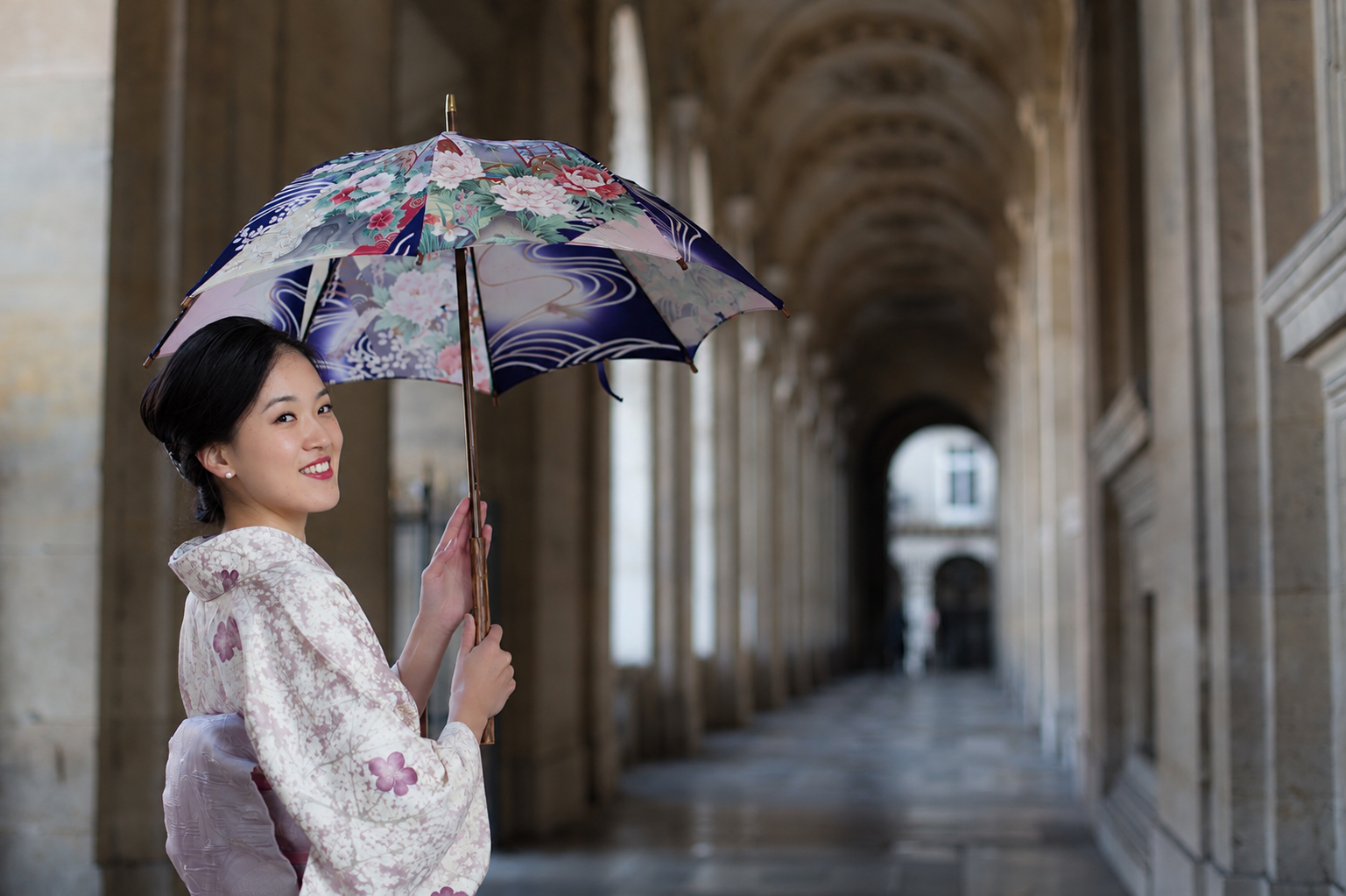
A furisode worn for a portrait session or a walk through a European city is not serving the same role as one worn for a coming-of-age celebration or as formal wedding guest attire, but it may invite curiosity, conversation, and cultural exchange.
Knowing how a garment has traditionally been worn gives us one way of seeing it. A new setting may add another.

This is one of the things I find most interesting about wearing kimono outside Japan. The garment does not arrive without a past, but neither does its story necessarily end with the context in which it was first worn.
What might it bring to a new place, a different occasion, or the people who encounter it there?
What Can We Bring to Kimono?
Throughout this series, we have looked at what different kimono can bring to a moment: celebration, memory, harmony, a sense of season, or simply a little more attention to an ordinary day.
But perhaps there is another question we can ask.
What can we bring to kimono?
When we choose clothing, we naturally think about what it can give us—how it will make us look, how it will make us feel, or what kind of experience it might create.
Kimono can certainly give us all of these things.
But I believe our relationship with kimono does not have to end with what we receive from it.
A vintage obi found in Japan may find a place in a family’s living room, adding color to the conversations shared there. A vintage kimono may walk through streets it was never expected to see. And a garment worn and cared for with attention today may, years from now, be loved and worn by someone else.
When a kimono or obi comes into our lives, it becomes part of our lives for a time. During that time, we can give something to it as well: care, another memory, another place, or another chapter in its life.
I do not think there is one answer to what that should look like.
I am still exploring what that means for me too—especially now, as I live with kimono in a place far from where it was made.
This journal is a place where I want to continue exploring that question with you: not only what kimono can bring to our lives, but what our lives can bring to kimono.
Each of us may find a different answer.
And those different answers can become part of where kimono goes next.
Explore the Complete Kimono Formality Series
- Understanding Kimono Formality: A Beginner’s Guide to Choosing the Right Kimono
- Japanese Wedding Kimono: A Guide to Bridal and Family Attire
- What Is a Furisode? Long Sleeves, Coming of Age, and the Meaning Behind Japan’s Formal Kimono
- Homongi vs. Tsukesage vs. Iromuji: How to Tell the Difference and When to Wear Each
- Casual Kimono vs. Yukata: Understanding Komon and How the Two Differ
- Kimono in Modern Japan and Beyond: How It Is Worn, Chosen, and Adapted Today
Experience Kimono in Paris
Curious to experience kimono for yourself?
Choose from more than 200 authentic Japanese kimono and yukata and discover how it feels to wear kimono in contemporary life, here in Paris.
→ Learn more about the Kimono Experience in Paris
Sources
- Agency for Cultural Affairs, Government of Japan. “FY2023 Research Report on Japanese Dress Culture”. [Japanese] This official report examines the historical development and present state of Japanese dress culture, including changes in kimono construction and dressing practices, the shift from everyday wear to occasion wear, dressing support, modern materials, and simplified forms of kimono and obi.
- Kyoto Kogei Sensho Cooperative Association. Kyoto Yuzen Encyclopedia: “Kimono Formality Rankings”, “Kimono TPO and Coordination”, and “Family Crests: Types, Number, and Placement”. [Japanese] These guides explain the traditional formality of different kimono, suitable occasions, seasonal coordination, obi and accessories, and the role of family crests.
- Yokohama National University. “Extra Chapter: Kimono”. The Education Program for the Cultural Folklore and for the Transmission of “Kimono” Culture. This English-language educational resource introduces kimono construction, different types of kimono, traditional TPO, seasonal and ceremonial use, and the adaptable nature of kimono’s flat construction.
- Victoria and Albert Museum. “Kimono: Kyoto to Catwalk”. This exhibition resource presents kimono as a dynamic and evolving form of dress, exploring how it has changed through fashion, social life, trade, artistic exchange, and its reception both within Japan and internationally.

Leave a Reply