
In the earlier articles in this series, we explored how kimono formality reflects the occasion, the wearer’s role, and the relationships surrounding it. We began with the basic structure of formality, then looked at wedding kimono and furisode, where clothing can become connected with ceremonial roles, shared celebration, life stages, family care, and memory.
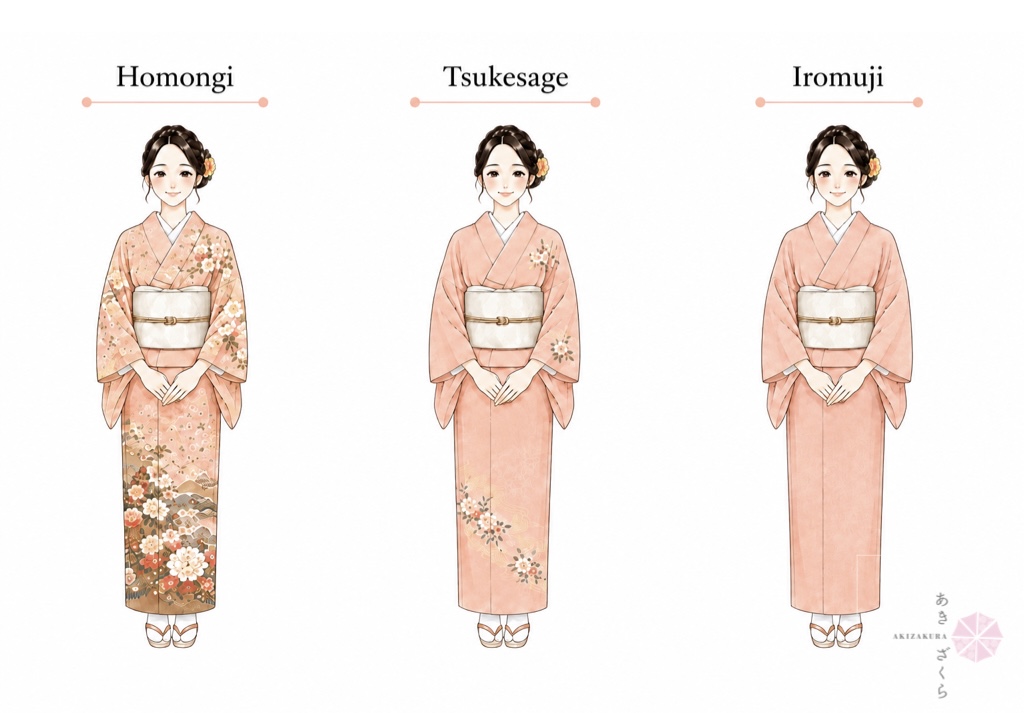
Homongi, tsukesage, and iromuji bring us to a more subtle area of kimono formality. All three may be worn by both married and unmarried women, and their differences are not always immediately obvious. A quiet homongi may resemble an elaborate tsukesage, while an iromuji may appear simple yet carry considerable formality.

These kimono are not simply three steps on a scale from more formal to less formal. Each creates presence within an occasion in a different way: homongi through a composition that moves across the body, tsukesage through carefully placed motifs and open space, and iromuji through quiet color, texture, crests, and coordination.
In this article, we will explore how homongi, tsukesage, and iromuji differ, how to recognize them through pattern placement, seam connections, open space, and motif arrangement, and how each may suit a different kind of occasion.
In This Article
・A Quick Comparison
・ Homongi — A Kimono Designed as One Composition
— What Is an Eba Design?
— Where Are the Patterns Placed?
— Is Homongi Always Bright and Luxurious?
— When Is Homongi Worn?
・ Tsukesage — Elegance Through Restraint
— What Does “Tsukesage” Describe?
— Do Tsukesage Patterns Cross the Seams?
— Is Tsukesage Less Formal Than Homongi?
— When Is Tsukesage Worn?
— How Do Homongi and Tsukesage Differ Before Tailoring?
— What Is a Tsukesage-Homongi?
・ Iromuji — The Beauty of One Color
— Is Iromuji Completely Plain?
— Why Is Black Excluded?
— How Crests Change an Iromuji
— Why Iromuji Is Valued in Tea Culture
・How to Tell Them Apart
・Harmony Within the Whole
・Three Different Expressions of Elegance
A Quick Comparison
| Homongi | Tsukesage | Iromuji | |
|---|---|---|---|
| Main characteristic | A coordinated pictorial composition often extending across seams | Smaller, more restrained motifs generally arranged to face upward | A single color without a prominent pictorial design |
| Overall impression | Flowing and pictorial | Restrained, with more open space | Quiet, shaped by color and texture |
| Pattern structure | Often connected as one composition | Usually more separate and limited | No prominent dyed picture; woven ground patterns may be present |
| Family crests | May be present and affect formality | May be present and affect formality | Especially important in determining formality |
| Possible occasions | Weddings as a guest, ceremonies, formal parties, and celebrations | Tea gatherings, ceremonies, parties, and elegant social events | Tea gatherings, ceremonies, celebrations, lessons, and refined outings, depending strongly on crests and coordination |
This table is a starting point rather than an absolute ranking. The suitability of each kimono also depends on its design, crests, obi, the wearer’s role, and the nature of the occasion. When an event has a host, school, or clear dress code, their guidance should take priority.
Homongi — A Kimono Designed as One Composition
The name homongi combines homon, meaning “visit,” and gi, meaning “clothing” or “dress.” It is generally classified as a semi-formal kimono and may be worn by both married and unmarried women.

One of the clearest visual features of homongi is its eba composition.
What Is an Eba Design?
In an eba design, the pattern is planned across the finished shape of the kimono, with motifs continuing naturally from one section to another across the seams.
A branch may extend from the body onto the sleeve. Flowing water may cross the front panel and okumi. Flowers or clouds may move from one section of the kimono into another.
The garment therefore appears less like separate patterned pieces and more like one coordinated composition designed around the wearer’s body.
Where Are the Patterns Placed?
Motifs may appear around the shoulders and chest, across the sleeves, and along the lower part of the front and back panels. They may also continue onto the okumi panel beside the front opening.
The full composition is revealed when the kimono is worn and viewed from several directions.
Is Homongi Always Bright and Luxurious?
No.
Some homongi use vivid color, gold, embroidery, and large auspicious designs. Others use pale colors, fine lines, abstract forms, or a small amount of decoration.
Brightness alone does not define a homongi. A more useful clue is whether the motifs have been planned as a coordinated composition across the garment.
When Is Homongi Worn?
Depending on its design, crests, obi, and the wearer’s role, homongi may be worn for weddings as a guest, school entrance and graduation ceremonies, formal receptions, family celebrations, and other important social occasions.
Because its composition unfolds across the body, homongi can give the wearer a distinct visual presence while adding to the sense of occasion.
Tsukesage — Elegance Through Restraint
Tsukesage may resemble homongi, but its pattern is generally more restrained.

Rather than creating one broad, connected composition, motifs are usually placed as smaller independent elements. A flower may appear near the shoulder, another on the sleeve, and several around the hem, with more open space between them.
What Does “Tsukesage” Describe?
The term tsukesage refers to a method of arranging motifs on a bolt of fabric so that they face upward once the kimono is sewn and worn.
Rather than being distributed evenly across the entire fabric, the motifs are positioned with their final location on the garment in mind.
Do Tsukesage Patterns Cross the Seams?
Traditionally, tsukesage has less extensive seam-crossing decoration than homongi.
A shoulder motif may remain separate from the sleeve. A design on the front may not continue fully across the okumi. The motifs may appear like carefully placed islands rather than one continuous scene.
However, it is not accurate to say that tsukesage patterns never cross seams. Some garments have limited connections, particularly between the front body and okumi.
Is Tsukesage Less Formal Than Homongi?
Tsukesage is generally described as more restrained and slightly less formal than homongi.
In practice, the design, crest, obi, and occasion still matter. It is better to see this as a general tendency, not a rule that applies perfectly to every kimono.
When Is Tsukesage Worn?
Depending on its design and coordination, tsukesage may suit tea gatherings, school entrance and graduation ceremonies, family celebrations, parties, cultural events, and other occasions where a refined but restrained appearance is desired.
Its open space creates a refined presence while allowing the atmosphere of the occasion to remain central.
How Do Homongi and Tsukesage Differ Before Tailoring?
Before final tailoring, the difference between homongi and tsukesage is often easier to see. Homongi is commonly presented in kari-eba form—temporarily basted into the shape of a kimono—so that its eba composition can be viewed as a whole. Tsukesage, by contrast, is traditionally sold as a bolt of fabric, with its motifs already positioned for the finished garment.

Once both have been tailored, we can no longer see whether the fabric was originally sold as a bolt or temporarily basted into kimono form. The pattern layout may still offer clues, but this is one reason why a restrained homongi and an elaborate tsukesage can be difficult to distinguish.
What Is a Tsukesage-Homongi?
The term tsukesage-homongi is generally used for a more elaborate form of tsukesage whose patterning approaches that of homongi.
Like other tsukesage, it is traditionally patterned while the fabric remains in bolt form. However, its motifs may be arranged to connect across selected seams—most characteristically between the front body and the okumi—and its overall composition may be more continuous and decorative than that of a restrained tsukesage.
A tsukesage-homongi may have:
- Patterns that connect across some seams but remain separate across others
- A more developed composition around the hem
- More elaborate decoration than a restrained tsukesage
- A composition that approaches—and may closely resemble—the eba effect of homongi
Once tailored, a tsukesage-homongi may be difficult—and sometimes impossible—to distinguish visually from a restrained homongi.
The term is not always used in exactly the same way. Some sellers use it for elaborate tsukesage with patterns that cross selected seams, while others make little distinction between tsukesage and tsukesage-homongi.
Kimono categories do not always have one perfectly sharp visual boundary. This is especially true with vintage garments, when we may no longer know how the fabric was originally produced or sold. In such cases, it may be more helpful to describe what can actually be seen—the placement of the motifs and the way they cross the seams—rather than forcing the kimono into one definite category.
Iromuji — The Beauty of One Color
Iromuji is a kimono dyed in a single color other than black.

The word combines iro, meaning color, and muji, meaning plain.
Its beauty comes from color, textile texture, and the way light moves across the surface rather than from a large dyed pictorial design.
Is Iromuji Completely Plain?
An iromuji does not have a dyed pictorial design of flowers, birds, landscapes, or objects.
However, the fabric may contain a woven ground pattern called jimon. Clouds, water, flowers, auspicious forms, or abstract textures may appear subtly as the light changes.

It can therefore look simple from a distance while revealing detail at close range.
Why Is Black Excluded?
In modern kimono classification, plain black formal kimono is treated separately.
Most notably, a plain black kimono with five dyed crests is worn with a black mourning obi and mourning accessories as formal mourning dress.
For this reason, iromuji generally refers to a plain-colored kimono in a color other than black.
How Crests Change an Iromuji
Crests are especially important for iromuji. An iromuji may be uncrested or bear one, three, or five crests, and the number of crests has a major effect on its formality.

The way the crest is made also matters. A resist-dyed crest, known as somenuki-mon, is generally considered more formal than an embroidered crest.
A one-crested iromuji is particularly versatile for semi-formal occasions. With an appropriate obi, it may be worn for tea gatherings, ceremonies, and celebrations.
An uncrested iromuji is generally easier to wear for lessons, cultural activities, refined meals, theatre visits, exhibitions, and elegant outings.
Three or five crests create a more formal garment, but they can also narrow the range of suitable occasions. The most formal version is not automatically the most useful one.
Why Iromuji Is Valued in Tea Culture
Iromuji is appreciated in tea culture because its quiet appearance can harmonize with the tea room.
It offers color and dignity while allowing the utensils, flowers, scroll, and atmosphere of the tea room to remain central.

With no pictorial scene, its expression comes through color, texture, coordination, and the quiet presence of the wearer.
Its formality can also be adjusted through the crest, obi, and accessories. The color and jimon should suit the season and purpose of the gathering.
The exact choice still depends on how formal the gathering is, the wearer’s role, the tea school, and the host’s guidance. Iromuji is versatile, but it is not the only kimono worn for tea.
How to Tell Them Apart
Step 1: Look for a Dyed Pictorial Design
If the garment is dyed in a single color and has no dyed pictorial design, it may be iromuji.
If dyed motifs are placed in specific areas of the garment, it may be homongi or tsukesage.
Remember that iromuji may still have a woven ground pattern that appears subtly as the light changes.
Step 2: Examine the Seams and Open Space
Look closely at the seams between the body and sleeves, between the front body panel and okumi, along the sides, and at the center back. Then step back and notice how much open space remains across the garment.
A design that continues across several seams as one coordinated composition suggests homongi. Smaller, more independent motifs with more open space between them suggest tsukesage.
This distinction is useful, but it is not absolute. A restrained homongi and an elaborate tsukesage may overlap visually, so seam connections, pattern placement, and open space should be considered together.
Step 3: Check Whether the Motifs Are Placed or Repeated
Tsukesage motifs are positioned with their final location on the garment in mind and generally face upward when the kimono is worn.
By contrast, komon—which will be explored in more detail in Part 5—usually features motifs that repeat across the fabric rather than being placed for specific areas of the finished garment.
Some komon designs repeat in different directions, while others have a clear orientation. Direction alone is therefore not enough to identify the kimono.
This clue is most useful when distinguishing tsukesage from komon. It does not separate tsukesage from homongi, since homongi patterns are also planned for the finished garment.
Harmony Within the Whole
Before bringing these differences together, I would like to look at them from a perspective shaped by the Japanese arts and traditions I encountered before kimono became the center of my work.
As I explored tea ceremony, ikebana, bonsai, Japanese gardens, and other forms of Japanese culture, I was repeatedly drawn to the idea of harmony. It became one of the principles behind AKIZAKURA and the way I hoped to share kimono with others.
Later, as I learned more about kimono formality, I began to see a connection with Japanese garden design. At Entsū-ji Temple in Kyoto, Mount Hiei is incorporated into the garden through shakkei, or “borrowed scenery.” Stones, hedges, pillars, trees, and the distant mountain are composed as one landscape. Each retains its own presence, yet its beauty is strengthened by its relationship to the whole.

To me, harmony does not mean disappearing into the background or suppressing one’s own presence. It means choosing an appearance whose beauty contributes to the whole—bringing out the fullest value of the occasion, honoring its purpose, and enriching the experience shared by everyone present.
Three Different Expressions of Elegance
Seen through this idea of harmony, formal rank is not a measure of beauty or worth. It helps describe the role a garment can play within an occasion.
Homongi brings movement and visual continuity through a composition that unfolds across the body. Tsukesage creates a more measured presence through carefully placed motifs and open space. Iromuji allows color, texture, light, and coordination to carry a quieter form of expression.
The most suitable choice is therefore not always the most decorative or the most formal. It is the kimono whose character can best enrich the occasion—supporting its atmosphere, reflecting the wearer’s role, and honoring the people who share it.
Choosing kimono can therefore be more than following rules. It can also be a way of noticing what a garment brings to the moment. Sometimes dignity is expressed through flowing imagery, sometimes through restraint, and sometimes through space, stillness, and what the garment chooses not to show.
Continue the Series
Next: Part 5 — Casual Kimono vs. Yukata
In Part 5, we will move toward the more relaxed side of kimono and compare komon with yukata. We will look at how their patterns, construction, dressing conventions, and use differ, and how both can bring traditional dress into ordinary life in different ways.
Read Part 5: Casual Kimono vs. Yukata: Understanding Komon and How the Two Differ →
Or Explore Another Part of the Series
Part 1: Understanding Kimono Formality: A Beginner’s Guide to Choosing the Right Kimono
Part 2: Japanese Wedding Kimono: A Guide to Bridal and Family Attire
Part 3: What Is a Furisode? Long Sleeves, Coming of Age, and the Meaning Behind Japan’s Formal Kimono
Part 6: Kimono in Modern Japan and Beyond: How It Is Worn, Chosen, and Adapted Today
Sources
- Yokohama National University. “Extra Chapter: Kimono.” The Education Program for the Cultural Folklore and for the Transmission of “Kimono” Culture.
https://kimono-bunka.ynu.ac.jp/kimono_en.html - Kimono no Sagami. “Kimono Types and TPO.” [Japanese]
https://sgm.co.jp/useful/tpo/ - Marusho Yokohama. “Differences in Kimono Pattern Placement: Eba Designs and Komon Patterns.” [Japanese]
https://www.hareginomarusho.co.jp/contents/kimono/2888/ - Erizen. “How to Tell Kimono Apart: Focusing on the Difference Between Homongi and Tsukesage.” [Japanese]
https://www.erizen.co.jp/blog/20250412_formal-kimono/ - Kanaiya. “Kimono Knowledge: Tsukesage.” [Japanese]
https://www.kanaiya.co.jp/mame/03-01.kimono-d-tukesage.htm - Marusho Yokohama. “Rules and Conventions for Kimono in Tea Ceremony.” [Japanese]
https://www.hareginomarusho.co.jp/contents/kimono/1105/ - Kyoto City Official Travel Guide. “Entsū-ji Temple.” [Japanese]
https://ja.kyoto.travel/tourism/single01.php?category_id=7&tourism_id=240

Leave a Reply