
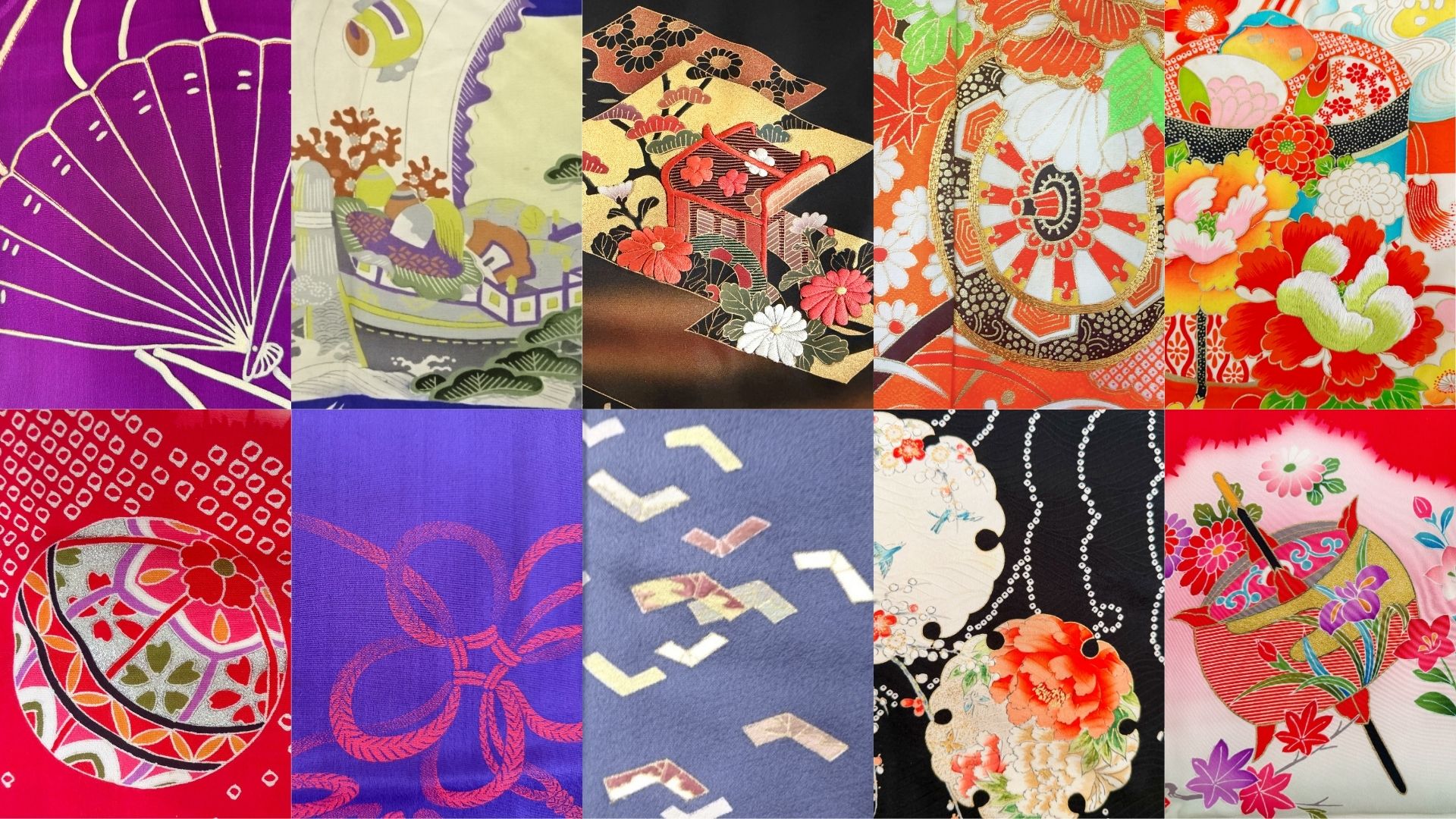
A guide to the meanings and symbolism of traditional objects, cultural symbols, and decorative motifs found on Japanese kimono.
In This Article
- Genjiguruma (Carriage Wheel)
- Goshoguruma (Court Carriage)
- Goshoningyo (Imperial Court Doll)
- Hamaguri (Clam Shell)
- Hyotan (Gourd)
- Itomaki (Thread Spool)
- Kaioke (Shell Container)
- Kakuremino (Magic Straw Raincoat)
- Kicho (Curtain Screen)
- Koma (Spinning Top)
- Kusuridama (Medicinal Ball)
- Mari (Decorative Ball)
- Monogatarimon (Narrative Motif)
- Musubi (Decorative Knot)
- Noshi (Ceremonial Gift Strips)
- Sensu (Folding Fan)
- Suzu (Bell)
- Takarabune (Treasure Ship)
- Takarazukushi (Treasure Collection)
- Tanzaku (Poetry Slip)
- Tsuzumi (Hand Drum)
- Uchiwa (Non-Folding Fan)
- Yokikotokiku (“Hear Good Things” Motif)
- Yukiwa (Snow Ring)
Genjiguruma (Carriage Wheel)

Meaning: Prosperity, continuity, and good fortune
The genjiguruma motif is based on the wheel of an ox-drawn court carriage used by aristocrats during the Heian period. Such carriages evoke the elegant courtly world of The Tale of Genji, which is reflected in the name genjiguruma.
In traditional interpretations, the continuously turning wheel came to symbolize continuity and enduring prosperity, giving the motif an auspicious association with good fortune that continues over time.
Genjiguruma motifs are often combined with flowers and other classical designs, adding to their association with the elegance of Japan’s courtly culture. The wheel itself has also been used as a decorative motif in textiles, crafts, and family crests.
Goshoguruma (Court Carriage)

Meaning: Prosperity, elegance, and noble status
The goshoguruma was an ox-drawn court carriage used by the imperial family and aristocracy during the Heian period. Closely associated with life at the imperial court, these elegant carriages came to evoke the refined world of the Japanese aristocracy and The Tale of Genji.
Because of this strong association with the imperial court and nobility, goshoguruma motifs came to symbolize elegance, prosperity, and high status. They also became auspicious designs expressing wishes for happiness and good fortune.
The motif has long been used in Japanese textiles and is especially well suited to formal and celebratory kimono.
Goshoningyo (Imperial Court Doll)

Meaning: Healthy growth, happiness, and family blessings
Goshoningyo are traditional Japanese dolls depicting plump, childlike figures with round faces and innocent expressions. They became closely associated with the imperial court and aristocratic culture, where they were used as gifts, including on occasions connected with children.
Because of their childlike form, goshoningyo came to embody wishes for children’s healthy growth, happiness, and a prosperous future. Their auspicious character also gave them associations with family happiness and blessings.
As a kimono motif, goshoningyo expresses wishes for healthy growth, happiness, and a prosperous family life.
Hamaguri (Clam Shell)

Meaning: Marital harmony, faithful partnership, and a happy marriage
Hamaguri, or clam shells, are made of two matching halves. Each pair fits together perfectly, and the shells cannot be matched with those of another clam.
Because of this unique quality, hamaguri became a symbol of marital harmony and fidelity. Matching shells were also used in kai-awase and became closely associated with wedding customs, expressing the wish for a couple to remain happily united.
As a kimono motif, hamaguri expresses wishes for a happy marriage, a faithful partnership, and lasting harmony between husband and wife.
Hyotan (Gourd)

Meaning: Good health, family prosperity, and success
Hyotan, or gourd, has long been regarded as an auspicious motif in Japan. Gourds produce many seeds, giving them an association with fertility, descendants, and the prosperity of future generations.
They are also connected with wishes for good health. A traditional wordplay links six gourds, mubyō, with mubyō meaning “free from illness,” making the motif an auspicious symbol of health and protection from misfortune.
Gourds also appear in traditions surrounding Chinese immortals. Li Tieguai, one of the Eight Immortals, is often depicted carrying a gourd containing magical medicine or the elixir of immortality, adding another association with health and longevity.
The gourd also became closely associated with Toyotomi Hideyoshi through his famous sennari-byōtan (“thousand gourds”) battle standard, adding an association with success and prosperity.
As a kimono motif, hyotan expresses wishes for good health, family prosperity, success, and abundant good fortune.
Itomaki (Thread Spool)

Meaning: Longevity, lasting connections, and continuity
Itomaki is a traditional spool used to wind and store thread. In the past, it was commonly used for silk threads, fishing lines, kite strings, and other cords needed in daily life.
The motif developed from this familiar tool. The long thread wound around the spool gave it an association with longevity and a long, prosperous life. Because thread also connects things together, itomaki came to express wishes for lasting relationships and meaningful connections.
Often combined with delicate floral patterns, itomaki motifs are particularly popular on kimono for young girls and are also used on kimono and obi.
Kaioke (Shell Container)

Meaning: Marital harmony, fidelity, and a happy marriage
A kaioke is an ornate container used to store shells for kai-awase, a traditional shell-matching game enjoyed by aristocrats from the Heian period.
In this game, the two halves of the same clamshell fit together perfectly, while shells from different clams do not match in the same way. Because of this unique quality, the shells came to symbolize fidelity, marital harmony, and the ideal bond between husband and wife.
Kaioke later became an important part of wedding trousseaux, particularly among samurai families during the Edo period. For this reason, the kaioke motif became an auspicious design expressing wishes for a happy and harmonious marriage and was especially favored on wedding garments.
Kakuremino (Magic Straw Raincoat)

Meaning: Protection, good fortune, and warding off misfortune
Kakuremino is a magical straw raincoat found in Japanese folklore. In Japanese folk traditions, straw raincoats and hats are also associated with supernatural beings and visiting deities, sometimes imagined as coming from beyond the human world.
In folktales, the kakuremino appears in particular as a magical treasure associated with supernatural beings such as tengu. By wearing it, a person was believed to become invisible.
The kakuremino later became one of the precious objects represented in takarazukushi (“treasure collection”), a classical auspicious motif associated with the arrival of good fortune.
As a traditional motif, kakuremino expresses wishes for protection from misfortune, safety, and good fortune.
Kicho (Curtain Screen)

Meaning: Elegance, refinement, and courtly beauty
A kichō was a portable curtain screen used in aristocratic residences during the Heian period. It was placed indoors as a partition or screen, providing privacy while also forming part of the elegant furnishings of courtly life.
The curtains of a kichō were often decorated with beautiful motifs of flowers, birds, and seasonal plants. Through its close association with Heian-period aristocratic culture, the kichō came to evoke refinement, elegance, and the classical beauty of the imperial court.
As a kimono motif, kichō brings an elegant and courtly atmosphere to the design and is often combined with flowers and other classical motifs.
Koma (Spinning Top)

Meaning: Strong will, prosperity, and good fortune
Koma, or spinning tops, have long been familiar toys in Japan. Because a spinning top turns around a straight central axis, it came to symbolize strong will, determination, and staying true to one’s path.
Its continuous spinning also inspired auspicious associations with money, work, and good fortune circulating smoothly. For this reason, koma came to be regarded as a lucky motif connected with prosperity and success.
As a kimono motif, koma expresses wishes for determination, success, prosperity, and good fortune.
Kusuridama (Medicinal Ball)

Meaning: Protection, purification, and good health
Kusuridama is an ornamental ball that developed from an old Chinese custom introduced to Japan and established at the imperial court during the Heian period. During the traditional May 5 festival known as Tango no Sekku, aromatic plants such as iris and mugwort were used to ward off evil and illness and to pray for good health.
Traditional kusuridama contained fragrant ingredients such as musk, agarwood, and cloves in brocade pouches. They were decorated with flowers and medicinal plants and finished with long, colorful threads, often in five colors.
Because kusuridama were associated with warding off evil and illness, they came to symbolize protection, purification, and good health. Their graceful floral form also made kusuridama an elegant decorative motif in Japanese textiles and kimono.
Mari (Decorative Ball)

Meaning: Happiness, harmonious relationships, and good fortune
Mari, or temari, are traditional Japanese balls made by winding and decorating thread around a round core. Originally used as toys, they gradually developed into beautifully decorated objects admired for their colorful patterns and craftsmanship.
Because temari are made with long threads, the motif came to be associated with lasting connections and good relationships. Their round shape also gave them an association with harmony and the wish for things to go smoothly, making mari an auspicious motif expressing happiness and a harmonious family life.
One traditional story tells that court ladies made decorative temari for young princesses, including as gifts connected with marriage. This tradition added to their association with happiness, affection, and wishes for a fortunate new stage of life.
Often combined with flowers and other elegant motifs, mari designs are especially familiar on kimono for girls and express wishes for a happy and fortunate future.
Monogatarimon (Narrative Motif)

Meaning: Literary refinement, cultural sophistication, and appreciation of classical literature
Monogatarimon refers to motifs inspired by scenes from classical Japanese literature, such as The Tale of Genji and The Tales of Ise. Rather than depicting an entire story directly, these designs often use symbolic objects, landscapes, plants, or other details to allude to well-known scenes.
Classical literature formed an important part of cultural education, and recognizing the references hidden within these motifs required familiarity with famous poems and stories. For this reason, monogatarimon came to reflect literary refinement, cultural sophistication, and an appreciation of Japan’s classical heritage.
The meaning of each design can vary depending on the story or scene being referenced. Some motifs evoke love, seasonal beauty, courtly life, or other themes drawn from the original tale.
Musubi (Decorative Knot)

Meaning: Meaningful bonds, lasting connections, and good relationships
Musubi refers to decorative knots and tied forms. The Japanese verb musubu means “to tie” or “to connect,” giving musubi motifs a natural association with bonds and relationships between people.
Because knots join separate elements and hold them together, musubi motifs came to express wishes for lasting connections, good relationships, and meaningful bonds. The idea of musubi also resonates with the ancient Japanese concept of musuhi, a generative power associated with creation, growth, and bringing things into being.
Knotted forms also appear in musubibumi, letters folded and tied into a knot-like shape. Such letters were used for love letters as well as formal correspondence, giving the motif an additional association with romantic bonds and meaningful encounters.
As a kimono motif, musubi expresses wishes for strong bonds, lasting relationships, and happiness shared with others.
Noshi (Ceremonial Gift Strips)

Meaning: Celebration, prosperity, longevity, and good wishes
Noshi originated from noshi-awabi, thin strips of abalone that were stretched and dried and traditionally used in ceremonial settings. They later came to be attached to gifts presented on auspicious occasions, becoming closely associated with celebration, respect, and good fortune.
The idea of stretching the abalone also gave noshi an association with longevity. Over time, its long, ribbon-like form was stylized into a decorative motif used in Japanese textiles.
When several noshi are gathered and tied together, the design is known as tabane-noshi (“bundled noshi”). This became a well-known auspicious motif used on kimono, including formal and celebratory garments.
As a kimono motif, noshi expresses wishes for celebration, prosperity, longevity, and good fortune.
Sensu (Folding Fan)

Meaning: Prosperity, growth, and good fortune
The folding fan has long been regarded as an auspicious symbol in Japan. As it opens, its shape widens from the base toward the outer edge. This form is known as suehirogari, or “widening toward the future,” and traditionally symbolizes growth, development, and increasing prosperity.
Fans have also played an important role in Japanese rituals, ceremonies, and performing arts, and in some contexts were associated with warding off evil and misfortune.
During the Heian period, elegant fans such as hiōgi were used at the imperial court. Their close connection with courtly culture also gave fan motifs an atmosphere of refinement, elegance, and classical beauty.
As a kimono motif, sensu expresses wishes for prosperity, good fortune, and a future that continues to expand and flourish.
Suzu (Bell)

Meaning: Protection, purification, and good fortune
Suzu, or bells, have long played an important role in Japanese Shinto rituals and festivals. Their clear sound was believed to purify people, ward off evil influences, and protect against misfortune.
At Shinto shrines, bells are rung before prayer, while kagura-suzu are used by shrine maidens during sacred dances. The sound of the bell is associated not only with purification but also with calling upon the presence and power of the kami.
Because of these associations, suzu became an auspicious motif symbolizing protection, purification, and good fortune. As a kimono design, it expresses wishes for safety, happiness, and a life protected from harm.
Takarabune (Treasure Ship)

Meaning: Good fortune, prosperity, and new beginnings
The takarabune, or treasure ship, is one of Japan’s best-known auspicious motifs. It is often depicted carrying the Seven Lucky Gods together with treasures such as treasure boxes, magical objects, and other symbols of wealth and good fortune.
The takarabune also has a strong connection with the Japanese New Year. During the Edo period, people placed pictures of treasure ships beneath their pillows in the hope of having an auspicious hatsuyume, or first dream of the New Year.
Because of these associations, the treasure ship came to symbolize good fortune, prosperity, and hopes for an auspicious beginning to the year.
Takarazukushi (Treasure Collection)

Meaning: Abundance, prosperity, and fulfilled wishes
Takarazukushi is an auspicious motif featuring a collection of treasures scattered across a design. Originating in China and later developing in distinctly Japanese forms, it has long been associated with inviting good fortune and blessings.
Common treasures include the nyoi-hoju (wish-fulfilling jewel), treasure scroll, treasure key, lucky mallet, treasure bag, magic cloak, magic hat, clove, noshi, and traditional balance weights. The exact combination varies depending on the period and design.
Each treasure carries its own symbolic meaning, but together they represent an abundance of blessings, prosperity, happiness, and good fortune. Because many auspicious objects are gathered into a single design, takarazukushi also expresses the hope that wishes will be fulfilled and good fortune will multiply.
For this reason, it has long been used on celebratory kimono and other textiles for auspicious occasions.
Tanzaku (Poetry Slip)

Meaning: Learning, literary refinement, and cultural accomplishment
Tanzaku are long, narrow strips of paper traditionally used for writing poetry and calligraphy or creating small paintings. They have long been closely associated with waka, haiku, and Japan’s literary and artistic traditions.
Because poetry and calligraphy were important forms of cultural accomplishment, tanzaku motifs came to evoke learning, literary refinement, and an appreciation of the classical arts. Designs may show individual slips decorated with flowers or writing, or tanzaku hanging from trees and bamboo.
As a kimono motif, tanzaku expresses an appreciation of learning, poetry, and artistic accomplishment.
Tsuzumi (Hand Drum)

Meaning: Good harvest, prosperity, and good fortune
Tsuzumi is a traditional Japanese hand drum with an hourglass-shaped body and two drumheads connected by cords. By adjusting the tension of the cords while playing, the musician can change the tone of the drum.
As a traditional motif, tsuzumi has an auspicious meaning based on Japanese wordplay. The word naru, meaning “to sound,” can also mean “to bear” or “to produce,” as when a plant bears fruit. The beautiful sound of the drum was therefore linked with the idea of crops bearing abundantly, giving the motif an association with a good harvest and prosperity.
The elegant form of the tsuzumi, closely associated with traditional performing arts such as Noh, also gives the motif a graceful and celebratory atmosphere. As a kimono design, it expresses wishes for prosperity, good fortune, and a fruitful life.
Uchiwa (Non-Folding Fan)

Meaning: Longevity and good fortune
Uchiwa is a traditional non-folding fan used to create a cooling breeze by waving it by hand. Introduced from China long ago, it developed a long history in Japan and eventually became a familiar part of everyday summer life.
The uchiwa also has an auspicious background connected with Chinese immortal traditions. It was associated with Zhongli Quan, one of the Eight Immortals, who is traditionally depicted carrying a magical fan. According to legend, his fan had the power to revive the dead, strengthening its association with immortality, longevity, and good fortune.
In Japan, uchiwa became closely associated with summer and coolness, making it a familiar motif on yukata and other summer textiles.
As a kimono motif, uchiwa evokes longevity and good fortune while also bringing a graceful sense of summer to the design.
Yokikotokiku (“Hear Good Things” Motif)

Meaning: Good fortune, good news, and auspicious wishes
Yokikotokiku is a traditional rebus motif based on Japanese wordplay. IIt combines an axe, read here as yoki, a koto, a traditional Japanese stringed instrument, and chrysanthemums, called kiku.. In some designs, the koto may instead be represented by the character for koto or by a kotoji, one of the movable bridges used on the instrument.
When these words are read together — yoki, koto, kiku — they sound like the Japanese phrase yoki koto kiku, meaning “to hear good things.” Because of this playful and auspicious wordplay, the motif expresses wishes for good news, happiness, and good fortune.
The design became popular during the Edo period as a type of hanjimono, or visual rebus, and was used on kimono and yukata. It also became associated with Kabuki actor Onoe Kikugoro, helping to make the motif especially fashionable in Edo.
Yukiwa (Snow Ring)

Meaning: Good harvest, purity, and good fortune
Yukiwa is a stylized circular motif representing snow, usually drawn with six rounded indentations around its edge. Snow has long been admired for its sixfold forms and is poetically called rikka, meaning “six-petaled flower.”
In Japan, snow has traditionally been regarded as an auspicious sign of a good harvest. Abundant snowfall was associated with a rich supply of meltwater for the fields, giving snow motifs a connection with fertility, abundance, and a fruitful year.
The pure whiteness of snow also gives yukiwa an association with cleanliness and purity. As a kimono motif, it expresses wishes for good fortune and abundance while bringing a graceful sense of seasonal beauty to the design.
Explore More Categories
Experience Kimono in Paris

Interested in wearing an authentic Japanese Kimono or Yukata?
Choose from more than 200 authentic kimono and yukata and discover Japanese culture in the heart of Paris.

Leave a Reply