
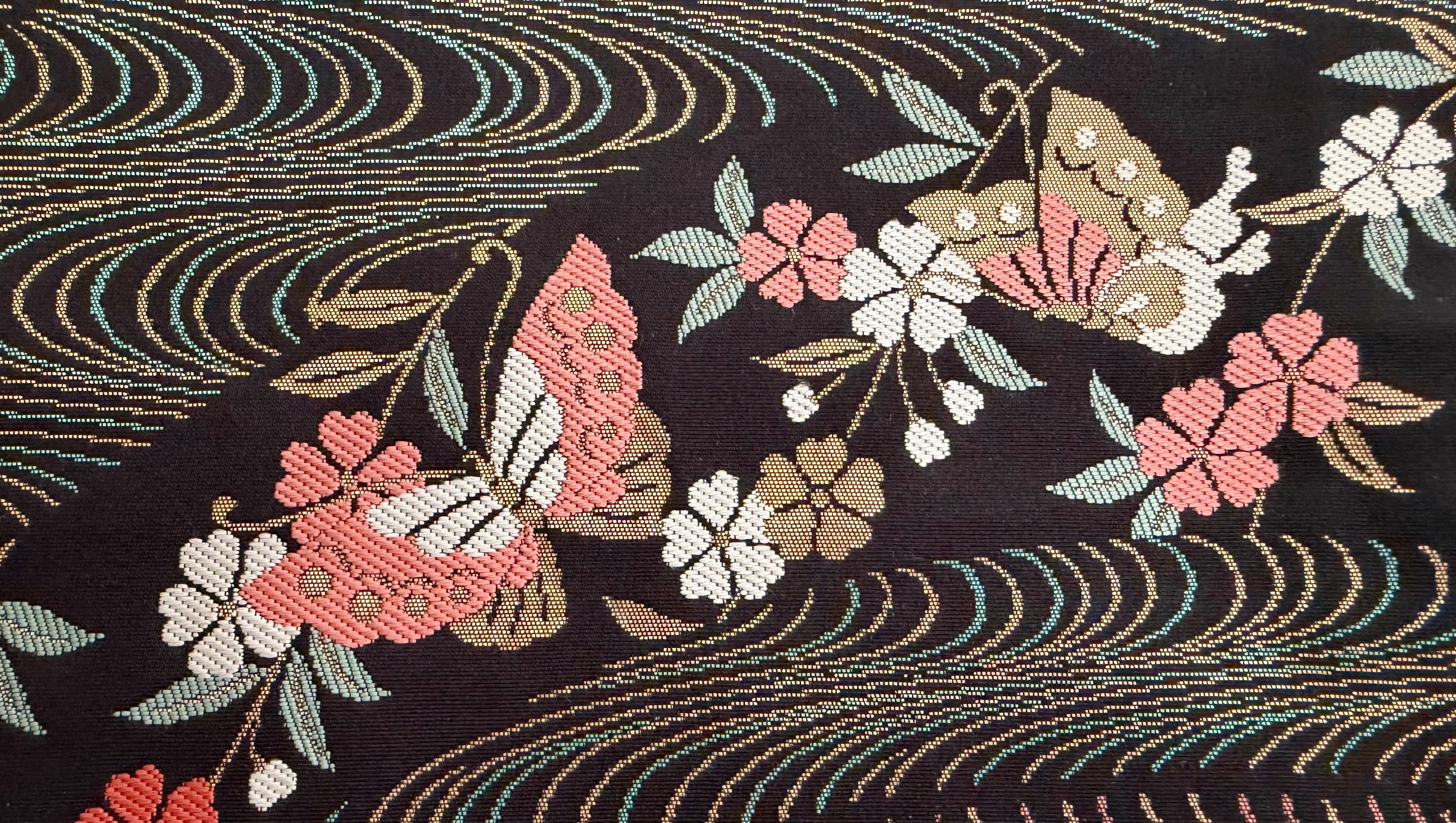
Japanese kimono patterns are more than decoration. Many carry wishes, values, and stories that have been passed down through generations.
Just as flowers and plants were used to express wishes and values, animals and birds have also played an important role in Japanese design for centuries.
People admired the unique qualities, stories, and cultural associations of different creatures and incorporated them into kimono motifs as symbols of their hopes and aspirations.
Here are some of the most beloved animal and bird motifs found on traditional kimono.
In This Article
- Tsuru (Crane)
- Kame (Turtle)
- Koi (Carp)
- Ryu (Dragon)
- Houou (Phoenix)
- Oshidori (Mandarin Ducks)
- Usagi (Rabbit)
- Chou (Butterfly)
- Tonbo (Dragonfly)
- Kingyo (Goldfish)
Tsuru (Crane)

Meaning: Longevity, good fortune, marital happiness, and prosperity
The crane is one of Japan’s most auspicious symbols. Traditionally believed to live for a thousand years, it became an emblem of longevity, good fortune, and a prosperous life.
Cranes have also long been regarded as sacred and auspicious birds. In traditional East Asian imagery, they were associated with the heavens and with legendary realms of immortality, giving them an additional sense of connection between heaven and earth.
Cranes are also known for forming lasting pair bonds. When depicted as a pair, they symbolize marital harmony, enduring love, and the wish for a happy life together. For this reason, crane motifs have long been cherished on wedding kimono and other celebratory garments.
Kame (Turtle)

Meaning: Longevity, good fortune, and a peaceful life
The turtle has long been regarded as a symbol of longevity and good fortune in Japan. This is reflected in the well-known saying, “The crane lives for a thousand years, the turtle for ten thousand.”
Because of these associations, turtles can also be found in Japanese temples, shrines, and traditional gardens, where they are regarded as auspicious creatures representing a long, healthy, and prosperous life.
These meanings are also reflected in kimono designs, where kame motifs express wishes for longevity, good fortune, and a peaceful and enduring life.
Koi (Carp)

Meaning: Determination, perseverance, and achievement
According to a well-known East Asian legend, a carp that succeeds in swimming upstream and ascending the powerful waterfall known as the Dragon Gate (Ryūmon) transforms into a dragon.
Because of this story, koi became a powerful symbol of perseverance, determination, and overcoming obstacles. The motif also came to express wishes for success, advancement, and the achievement of important goals.
For these reasons, koi has long been cherished as an auspicious motif in Japanese art and kimono.
Ryu (Dragon)

Meaning: Power, authority, success, and divine protection
Ryu, or dragon, is a mythical creature that originated in ancient China and later became an important motif in Japan. It was believed to rise to the heavens and control clouds and rain, making it a sacred being connected with water, nature, and divine power.
In East Asian tradition, the dragon is one of the Four Auspicious Creatures, together with the phoenix, qilin, and turtle. In another traditional system, the Azure Dragon (Seiryū) is one of the Four Guardian Deities and protects the eastern direction.
As a kimono motif, the dragon symbolizes authority, strength, protection, and good fortune. A dragon rising toward the sky, known as shōryū, is especially auspicious, representing advancement, success, and the wish to rise higher in life.
Houou (Phoenix)

Meaning: Peace, prosperity, virtue, and good fortune
The houou is a legendary bird often compared to the phoenix. In East Asian tradition, it is regarded as the king of birds and a sacred creature said to appear during times of peace and good governance.
Unlike an ordinary bird, the houou is a mythical being described as combining features of several animals. Its magnificent appearance and association with a peaceful and flourishing world made it a symbol of virtue, prosperity, and good fortune.
In one traditional explanation, hō refers to the male bird and ō to the female, giving the name an additional association with harmony and balance. As a bird believed to appear in an age of peace and prosperity, the houou became one of the most prestigious auspicious motifs in Japanese art and kimono.
Oshidori (Mandarin Ducks)

Meaning: Marital happiness, lasting love, and harmonious relationships
In Japan, devoted couples are often described as oshidori fūfu (“a pair of mandarin ducks”). For centuries, oshidori have symbolized lasting affection, marital harmony, and loving partnerships.
Traditionally depicted in pairs, oshidori came to represent couples who support and cherish one another. For this reason, the motif expresses wishes for a happy marriage, lasting love, and a harmonious relationship.
These auspicious associations also made oshidori a beloved motif in wedding and celebratory designs, where they symbolize enduring love and happiness.
Usagi (Rabbit)

Meaning: Progress, good fortune, and family prosperity
The rabbit has long been regarded as an auspicious motif in Japan. Because rabbits leap forward with great energy, they came to symbolize progress, growth, and the ability to move ahead in life.
Rabbits are also associated with family prosperity. Their ability to reproduce quickly made them symbols of abundance and wishes for future generations.
Rabbits also have a deep connection with the moon in Japanese culture. The familiar image of the rabbit on the moon has inspired many traditional designs, adding another layer of cultural meaning to the motif.
Chou (Butterfly)

Meaning: Transformation, renewal, beauty, and longevity
The butterfly has long been admired in Japan as a symbol of transformation and renewal. Its journey from caterpillar to butterfly came to represent growth, positive change, and new beginnings.
Butterflies are also associated with longevity. One traditional interpretation connects the sound of chō (“butterfly”) with the character chō (長), associated with length or longevity, giving the motif an auspicious connection with long life.
Butterflies are also associated with beauty and elegance, and their transformation gives the motif a sense of growth and renewal. For this reason, butterfly motifs came to express wishes for happiness, beauty, and a flourishing life.
Personally, wearing butterfly motifs reminds me that even difficult times may simply be part of the journey toward becoming something new and beautiful.
Tonbo (Dragonfly)

Meaning: Victory, courage, determination, and moving forward
The dragonfly has long been regarded as an auspicious insect in Japan. Traditionally, it was said to fly straight ahead without retreating, making it a symbol of determination, progress, and the courage to move forward.
Dragonflies came to be known as kachimushi (“victory insects”) and were especially favored by samurai. Their motifs appeared on armor, weapons, and garments, expressing wishes for victory, perseverance, and success.
As a kimono motif, tonbo expresses determination, courage, good fortune, and the strength to keep moving forward.
Kingyo (Goldfish)

Meaning: Wealth, prosperity, and fertility
Kingyo, or goldfish, became an auspicious motif through Chinese wordplay. In Chinese, “goldfish” is associated with jinyu, sounding like an expression meaning “surplus gold” or “money remaining.” This gave the motif a strong association with wealth, prosperity, and financial good fortune.
Goldfish also lay many eggs, so they came to symbolize fertility, abundance, and wishes for many descendants. When goldfish were first introduced to Japan, they were rare and expensive, enjoyed mainly by wealthy people. By the middle of the Edo period, however, they had become more widely available and increasingly popular among ordinary people.
Because of their graceful movement and refreshing appearance, goldfish became especially popular as a summer motif and continue to appear on summer kimono and yukata.
Continue Exploring Kimono Patterns
This article introduced 10 beloved animal and bird motifs often found on Japanese kimono.
To explore more animal and bird motifs in detail, visit the full dictionary.
→ Explore the Animals & Birds Dictionary
Experience Kimono in Paris

Interested in wearing an authentic Japanese kimono or yukata?
Choose from more than 200 authentic kimono and yukata and discover Japanese culture in the heart of Paris.
Leave a Reply