
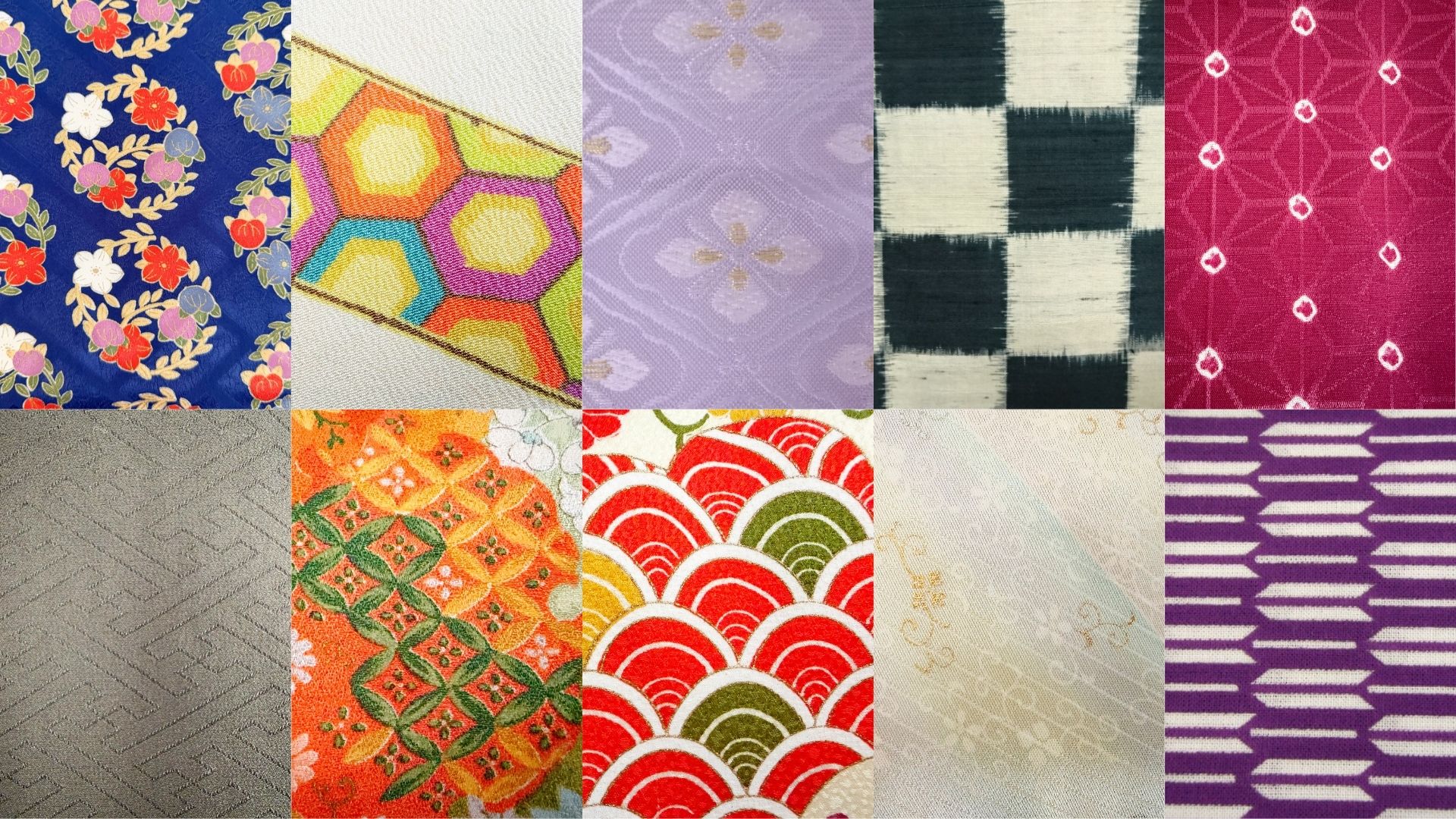
A guide to the meanings and symbolism of geometric and auspicious patterns found on Japanese kimono.
In This Article
- Amime (Net Pattern)
- Asanoha (Hemp Leaf Pattern)
- Bishamonkikko (Bishamon Tortoiseshell Pattern)
- Gyogi (Diagonal Dot Pattern)
- Hanabishi (Flower Diamond Pattern)
- Hishigata (Diamond Pattern)
- Ichimatsu (Checkerboard Pattern)
- Igeta (Well Frame Pattern)
- Kagome (Basket Weave Pattern)
- Kakudoshi (Aligned Square Pattern)
- Kanzesui (Flowing Water Pattern)
- Karakusa (Scrolling Vine Pattern)
- Kikko (Tortoiseshell Pattern)
- Kojitsunagi (Linked I-Shapes Pattern)
- Kōrinmizu (Kōrin Water Pattern)
- Koshi (Lattice Pattern)
- Kumo (Cloud Motif)
- Mameshibori (Tiny Tie-Dye Dots)
- Marumon (Circular Motif)
- Mizutama (Polka Dots)
- Ryusui (Flowing Water)
- Same (Sharkskin Pattern)
- Sayagata (Linked Manji Pattern)
- Seigaiha (Blue Ocean Waves)
- Shippo (Seven Treasures)
- Uroko (Scale Pattern)
- Yabane (Arrow Feather Pattern)
Amime (Net Pattern)

Meaning: Good fortune, abundance, and prosperity
Amime is a net-like pattern inspired by the crossing lines of fishing nets. Its rhythmic curved design became especially popular during the Edo period.
When combined with fish, shrimp, octopus, and other sea creatures, amime was used in tairyōmon, or “abundant catch” motifs, giving the pattern a strong association with abundance and prosperity.
In auspicious interpretations, a net is also said to “catch” or “scoop up” good fortune and keep it from slipping away. For this reason, amime came to express wishes for prosperity, abundance, and blessings that remain in one’s life.
As a kimono pattern, amime expresses wishes for good fortune, abundance, and lasting prosperity.
Asanoha (Hemp Leaf Pattern)

Meaning: Healthy growth, strength, and protection
Asanoha is a geometric pattern formed from repeating star-like shapes based on regular hexagons. Its name, meaning “hemp leaf,” comes from the pattern’s resemblance to the leaves of the hemp plant.
Hemp grows quickly, straight, and strong, and its fibers are known for their durability. Because of these qualities, asanoha came to symbolize vitality, strength, and healthy growth.
In traditional interpretations, the geometric structure of the pattern, formed from repeating triangles and hexagons, was also associated with protection and warding off misfortune.
For these reasons, asanoha was especially favored for babies’ and children’s garments, expressing wishes that they would grow up healthy, strong, and protected from harm.
Bishamonkikko (Bishamon Tortoiseshell Pattern)

Meaning: Wealth, protection, and good fortune
Bishamonkikko is a geometric pattern formed by combining three hexagonal kikko, or tortoiseshell shapes, into a repeating design. Its name is said to come from Bishamonten, one of the Four Heavenly Kings, because this distinctive pattern was traditionally associated with the armor depicted on images of the deity.
The underlying kikko pattern is itself an auspicious motif associated with longevity, reflecting the long life traditionally attributed to turtles. Bishamonkikko adds the symbolism of Bishamonten, a guardian deity who was also associated with wealth, blessings, and good fortune.
In Japan, Bishamonten later became one of the Seven Lucky Gods, further strengthening the motif’s connection with prosperity and good fortune. As a kimono pattern, bishamonkikko expresses wishes for protection, prosperity, success, and blessings.
Gyogi (Diagonal Dot Pattern)

Meaning: Respect, proper conduct, and courtesy
Gyogi is one of the three classic high-ranking patterns of Edo Komon, together with same and kakudoshi. It is formed from tiny dots arranged in regular diagonal lines, typically at about 45 degrees.
The Japanese word gyogi refers to proper manners or conduct. Traditionally, the diagonal arrangement of the dots has also been associated with the angle of the body when making a respectful bow. For this reason, the pattern came to express gyogi-saho, or proper etiquette, and the idea of showing respect and courtesy to others.
As a kimono pattern, gyogi conveys dignity, proper conduct, and a spirit of treating others with respect.
Hanabishi (Flower Diamond Pattern)

Meaning: Courtly elegance, refinement, and noble status
Hanabishi is a traditional motif in which a four-petaled stylized flower is arranged in a diamond shape. It developed as one of the classical patterns associated with yūsoku mon’yō, the formal decorative tradition of the Japanese imperial court and aristocracy.
During and after the Heian period, diamond-based patterns were widely used in courtly textiles and formal dress. Through this close association with aristocratic culture, hanabishi came to evoke elegance, refinement, and noble status.
The design was also adopted as a family crest and developed into many variations, including forms combined with vines, swords, tortoiseshell patterns, and other classical motifs.
As a kimono motif, hanabishi brings a sense of classical elegance, dignity, and refined beauty to the design.
Hishigata (Diamond Pattern)

Meaning: Family prosperity, good health, and vitality
Hishigata is a traditional diamond-shaped geometric pattern. Its name comes from hishi, an aquatic plant whose leaves and fruit were thought to resemble the diamond shape.
The hishi plant grows vigorously and spreads across the surface of the water. Because of its strong vitality and reproductive power, the motif came to be associated with the prosperity of future generations and the continuation of the family. Diamond-based patterns also became part of the classical yūsoku mon’yō tradition used in courtly textiles.
The motif has also traditionally been associated with mubyō-sokusai — good health and freedom from illness. As a kimono pattern, hishigata expresses wishes for family prosperity, vitality, and a healthy life.
Ichimatsu (Checkerboard Pattern)

Meaning: Continuity, prosperity, and enduring growth
Ichimatsu is a geometric pattern made of alternating squares arranged in a checkerboard design. Before it became known as ichimatsu, the pattern was called ishidatami, meaning “stone pavement,” and had been used in Japan for centuries.
The name ichimatsu became popular during the Edo period after the kabuki actor Sanogawa Ichimatsu famously wore the pattern on stage, helping to make the design fashionable in kimono and other decorative arts.
Because the squares continue without interruption in every direction, the pattern came to symbolize continuity, development, and prosperity that continues into the future. For this reason, ichimatsu has long been regarded as an auspicious design associated with enduring growth and good fortune.
Igeta (Well Frame Pattern)

Meaning: Household safety, prosperity, and financial good fortune
Igeta is a geometric pattern based on the wooden frame built around the top of a traditional Japanese well. Wells were once essential sources of water for everyday life, and the frame helped protect the well, an essential source of water for everyday life.
Because the igeta protected such an important source of daily life, the motif came to be associated with household safety and stability.
In some auspicious interpretations, wells and the water they provide are also associated with wealth and prosperity. This gave igeta an additional connection with financial good fortune and a flourishing household.
As a kimono pattern, igeta expresses wishes for household safety, prosperity, and a secure and fortunate life.
Kagome (Basket Weave Pattern)

Meaning: Protection, warding off evil, and inviting blessings
Kagome is a geometric pattern inspired by the woven structure of bamboo baskets. In Japanese folk belief, baskets were sometimes associated with spiritual protection, and their many openings were believed to ward off evil influences.
In some traditional interpretations, the space inside a basket could also be regarded as a sacred or otherworldly place associated with spiritual presence. This gave the basket a dual symbolism: keeping harmful influences away while welcoming benevolent or sacred presence.
As a kimono pattern, kagome expresses wishes for protection, safety, and the invitation of blessings and good fortune.
Kakudoshi (Aligned Square Pattern)

Meaning: Integrity, consistency, and steadfast principles
Kakudoshi is one of the classic Edo Komon patterns. It is made of tiny square dots arranged at equal intervals in regular vertical and horizontal rows.
Because the pattern runs straight and consistently in both directions, it is associated with the Japanese expression suji o tōsu — to remain true to one’s principles and act with integrity and consistency.
As a kimono pattern, kakudoshi expresses integrity, steadfast character, and the importance of remaining true to one’s principles.
Kanzesui (Flowing Water Pattern)

Meaning: Purity, integrity, and continuous renewal
Kanzesui is a stylized flowing-water pattern associated with the Kanze school of Noh theater. Its graceful design is characterized by flowing lines, oval ripples, and whirlpool-like forms.
According to tradition, the pattern was inspired by the swirling water of a well at the Kanze family’s residence in Kyoto. A legend even tells that a dragon descended into this well, adding a mysterious layer to the motif’s history.
Kanzesui has also been interpreted through the saying ryūsui kusarazu — “flowing water does not decay.” Water that continues to move does not stagnate, giving the motif associations with purity, integrity, renewal, and continuing forward without stagnation.
As a kimono pattern, kanzesui expresses wishes for clarity, integrity, renewal, and a life that continues to move forward.
Karakusa (Scrolling Vine Pattern)

Meaning: Vitality, longevity, prosperity, and family continuity
Karakusa is a flowing plant pattern formed from leaves and flowers connected by rhythmic, winding vines. Related designs can be found as far back as ancient Egypt and Mesopotamia and reached Japan via the Silk Road, where they developed into many distinctive Japanese variations.
Because the vines seem to grow and extend endlessly, karakusa came to symbolize strong vitality, longevity, and continuing prosperity. Their vigorous growth also gave the motif an association with flourishing descendants and the continuation of the family line.
As a kimono pattern, karakusa expresses wishes for vitality, prosperity, long life, and blessings that continue from one generation to the next.
Kikko (Tortoiseshell Pattern)

Meaning: Longevity, protection, and good fortune
Kikko is a geometric pattern of regular hexagons inspired by the shell of a turtle. Because turtles have long been regarded in Japan as auspicious animals associated with long life, kikko became a traditional symbol of longevity and good fortune.
The motif also has a spiritual background. Turtle shells were used in ancient divination and came to be associated with divine protection. In Chinese mythology, the sacred turtle was also connected with Mount Horai, the legendary home of immortals, further strengthening its association with longevity.
As a kimono pattern, kikko expresses wishes for longevity, protection, and a fortunate life.
Kojitsunagi (Linked I-Shapes Pattern)

Meaning: Longevity, enduring continuity, and family prosperity
Kōji-tsunagi is a continuous geometric pattern formed by linking stylized shapes of the kanji character kō (工) in a regular repeating design.
Because it is a tsunagi pattern — a design that continues without interruption — it came to symbolize fudan chōkyū, the wish for something to continue for a long time without ending. It is therefore associated with longevity, prolonged life, and the continuation of future generations.
As a kimono pattern, kōji-tsunagi expresses wishes for long life, family prosperity, and blessings that continue over time.
Kōrinmizu (Kōrin Water Pattern)

Meaning: Purity, renewal, and continuous flow
Kōrinmizu is a decorative flowing-water pattern associated with Ogata Kōrin, one of the great artists of the Edo period. Its distinctive curving streams and swirling forms are famously seen in his Red and White Plum Blossoms folding screen and later developed into a widely admired decorative motif.
Like other traditional flowing-water patterns, kōrinmizu is associated with purity and renewal. Flowing water was also believed to carry away misfortune, giving water motifs a protective meaning.
The motif can also be interpreted through the saying that “flowing water does not decay”: water that continues to move does not stagnate. This gives kōrinmizu an additional association with continuing forward, renewal, and a life that remains clear and vital.
As a kimono pattern, kōrinmizu expresses purity, renewal, and continuous movement while also evoking the refined decorative beauty of Kōrin and the Rinpa tradition.
Koshi (Lattice Pattern)

Meaning: Protection, warding off evil, and safety
Koshi is a geometric lattice pattern formed by vertical and horizontal lines crossing to create a regular grid. It is an ancient design in Japan and became especially popular during the Edo period in many different variations.
In one traditional interpretation, the many square openings of the lattice were seen as watchful eyes guarding against harmful influences. For this reason, koshi came to be associated with warding off evil and keeping misfortune away.
As a kimono pattern, koshi expresses wishes for protection, safety, and a life guarded from harm.
Kumo (Cloud Motif)

Meaning: Auspicious signs, divine blessings, abundance, and mystery
Kumo, or cloud motifs, have long carried auspicious meanings in East Asian and Japanese design. Certain clouds, known as zuiun or “auspicious clouds,” were traditionally regarded as signs that something favorable was about to occur.
Clouds also appear in religious and traditional imagery alongside deities and celestial beings, giving them an association with the sacred, the heavens, and a mysterious world beyond ordinary human reach.
Because clouds bring rain, they are also connected with fertile land, abundant harvests, and prosperity.
As a kimono motif, kumo expresses wishes for good fortune, divine blessings, abundance, and favorable change, while also bringing a sense of mystery to the design.
Mameshibori (Tiny Tie-Dye Dots)

Meaning: Family prosperity, good health, and protection
Mameshibori is a traditional pattern of small, bean-like dots. The name comes from mame, meaning beans, and the pattern was originally created using tie-dye techniques.
Because a single bean can produce many more beans when planted, the motif came to be associated with flourishing descendants and family prosperity.
The word mame is also associated with being healthy and strong in Japanese wordplay, giving the pattern a traditional meaning of good health and freedom from illness. In another traditional interpretation, the small dots resemble eyes, giving mameshibori a protective meaning associated with warding off evil.
As a kimono pattern, mameshibori expresses wishes for family prosperity, good health, and protection from misfortune.
Marumon (Circular Motif)

Meaning: Infinity, continuity, and good fortune
Marumon is a traditional motif in which decorative designs are arranged within a circular form. Circular motifs have a long history in Japanese design, developing from ancient patterns introduced from the Asian continent into distinctive Japanese forms during the Heian period.
Because a circle has no beginning and no end, marumon came to be associated with infinity, continuity, and harmony. The unbroken circular form has also been regarded as auspicious, expressing wishes for lasting happiness and good fortune.
Marumon often contains flowers, birds, seasonal plants, and other symbolic motifs within the circle. These designs can add further layers of meaning and auspicious wishes.
As a kimono pattern, marumon expresses continuity, harmony, and lasting good fortune, while the motifs contained within each circle can carry their own additional meanings.
Mizutama (Polka Dots)

Meaning: Individuality, playfulness, and creative expression
Mizutama, or polka dots, is a pattern of repeated round shapes. Unlike many traditional Japanese motifs, it does not have one fixed symbolic meaning, although circular designs have appeared in Japanese textiles for centuries.
One striking example is an Edo-period jinbaori decorated with large circles in five colors. Interestingly, although it is known today as a “polka-dot” design, an old inventory of the Date family described the circles as ransei, or “scattered stars.”
Because mizutama can vary freely in size, color, and arrangement, it lends itself naturally to playful and individual expression in kimono and yukata design.
As a kimono pattern, mizutama brings a sense of individuality, creativity, and lively charm.
Ryusui (Flowing Water)

Meaning: Purity, protection, continuity, and renewal
Ryusui is a traditional motif depicting flowing water, streams, and rivers. Flowing-water patterns have a very long history in Japan, with designs known as ryusuimon appearing as early as the Yayoi period.
Flowing water is associated with purity and cleansing. Because water carries things away as it moves, ryusui also came to symbolize washing away misfortune and warding off harmful influences.
Its continuous movement gives the motif an additional association with renewal and a life that keeps moving forward without stagnation.
Ryusui is often combined with seasonal flowers, fans, carriages, bridges, and other motifs, connecting them into graceful flowing landscapes.
As a kimono pattern, ryusui expresses wishes for purity, protection, renewal, and a life that continues to flow smoothly.
Same (Sharkskin Pattern)

Meaning: Protection, warding off evil, and safety
Same, or sharkskin pattern, is one of the classic Edo Komon designs. It is made of tiny dots arranged in overlapping fan-like curves, creating a texture that resembles sharkskin.
Because sharkskin was regarded as tough and hard, it was likened to armor protecting the body. For this reason, same came to be associated with protection, warding off evil, and keeping misfortune away.
As a kimono pattern, same expresses wishes for safety, protection, and a life guarded from harmful influences.
Sayagata (Linked Manji Pattern)

Meaning: Longevity, prosperity, and continuity
Sayagata is a geometric pattern formed by a continuous series of interlocking manji (卍) symbols. Its name comes from a silk textile called saya, imported from China during the Momoyama period, on which this design was used as a woven ground pattern.
Because the pattern continues endlessly without interruption, it came to express fudan chōkyū — the wish for something to continue for a long time without ending — giving it associations with longevity, family prosperity, and lasting good fortune. The manji itself is an ancient Buddhist auspicious symbol associated with virtue and good fortune.
As a kimono pattern, sayagata expresses wishes for longevity, prosperity, and blessings that continue across generations.
Seigaiha (Blue Ocean Waves)

Meaning: Endless happiness, peace, and prosperity
Seigaiha is a traditional pattern of overlapping fan-shaped waves that spread endlessly across the surface. Its name is associated with Seigaiha, an ancient gagaku court dance in which performers wore costumes decorated with this pattern.
The endlessly repeating waves came to symbolize the wish that happiness and a peaceful life would continue far into the future. Their calm, expansive form also gave the motif an association with lasting prosperity.
As a kimono pattern, seigaiha expresses wishes for enduring happiness, peace, and a prosperous life that continues across generations.
Shippo (Seven Treasures)

Meaning: Harmony, lasting connections, and prosperity
The shippō pattern is created by overlapping circles of equal size, forming an endless chain of interconnected shapes. Because the circles continue without interruption, the motif came to symbolize harmony, lasting relationships, and the continuation of prosperity.
One theory suggests that the name shippō developed from shihō, meaning “four directions,” reflecting the way the pattern spreads continuously in every direction. The name also became associated with the Buddhist shippō, or “Seven Treasures,” adding another auspicious layer of wealth and blessings to the motif.
As a kimono pattern, shippō expresses wishes for harmonious relationships, enduring connections, and prosperity that continues across generations.
Uroko (Scale Pattern)

Meaning: Protection, rebirth, and warding off misfortune
Uroko is a geometric pattern made of repeating triangular shapes resembling the scales of fish or snakes.
Because snakes repeatedly shed their skin, the motif came to be associated with casting off misfortune, renewal, and rebirth. It was also regarded as a protective pattern for warding off evil and harm.
The connection with snakes can also be seen in traditional performing arts. In Noh theater, uroko patterns are used symbolically for characters associated with snakes and dragons, as in Dōjōji.
As a kimono pattern, uroko expresses wishes for protection, renewal, and the strength to leave misfortune behind.
Yabane (Arrow Feather Pattern)

Meaning: Protection, success, and good fortune
Yabane is a traditional motif based on the feathers attached to Japanese arrows, often made from the feathers of eagles and hawks. Because arrows were associated with hamaya, or “evil-destroying arrows,” the motif came to carry a protective meaning connected with warding off evil and misfortune.
An arrow that hits its target also became an auspicious image of achieving one’s goals, giving yabane associations with success and good fortune.
Another traditional association comes from the fact that an arrow does not return once it has been released. During the Edo period, yabane patterns were therefore included in a bride’s trousseau as an auspicious wish that she would not return to her parental home after marriage.
As a kimono pattern, yabane expresses wishes for protection, success, and the strength to move forward toward one’s goals.
Explore More Categories
Experience Kimono in Paris

Interested in wearing an authentic Japanese Kimono or Yukata?
Choose from more than 200 authentic Kimono and Yukata and discover Japanese culture in the heart of Paris.

Leave a Reply