
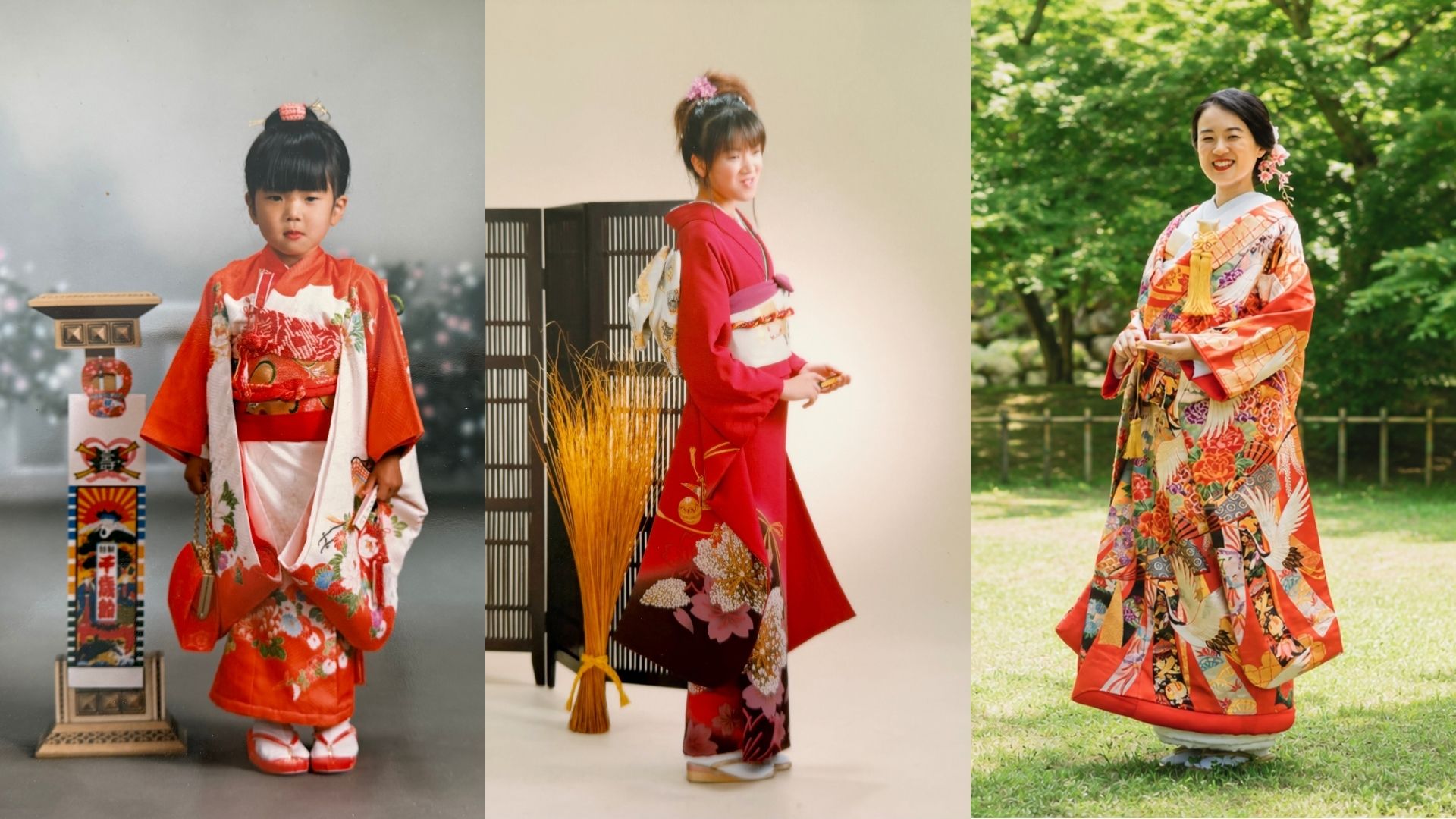
When I was offering kimono experiences in Japan, one of the questions I was often asked was:
“When do Japanese people actually wear kimono?”
For many people in Japan today, kimono is no longer part of everyday life. And yet it has not disappeared from Japanese life either.
If we follow a person through different stages of life, kimono appears again and again: when a baby is welcomed, when a child’s growth is celebrated, when someone turns twenty or graduates, at weddings, and sometimes when saying goodbye to someone who has died.
Of course, not every person will wear kimono at all of these moments. Customs and choices vary between families, regions, generations, and occasions.
To answer that question, I’d like to follow some of these moments through a person’s life, beginning with one of the earliest: omiyamairi.
In This Article
・Omiyamairi — A Baby’s First Shrine Visit
・Shichi-Go-San — Celebrating Growth at Three, Five, and Seven
・At Ten — A Newer “Half Coming-of-Age” Celebration
・Coming of Age — Furisode at Twenty
・Graduation — Kimono and Hakama
・Weddings — Dressing for Celebration and Relationship
・Kimono in Mourning — Dressing for a Farewell
・Kimono and the Days We Set Apart
Omiyamairi — A Baby’s First Shrine Visit
Omiyamairi, also called hatsumiyamairi, is traditionally a baby’s first formal visit to a Shinto shrine.
The family visits a shrine to report the baby’s birth, give thanks for a safe arrival, and pray for the child’s health and future growth. Traditionally, this was closely connected with the local ujigami, the deity associated with and protecting the community. Historically, the visit was also connected with the idea of the child becoming part of the local shrine community.
Traditionally, omiyamairi was held around one month after birth, with the 31st day for boys and the 33rd day for girls commonly cited. Customs vary by region, however, and today many families choose a date according to the health of the baby and mother, the weather, and their own circumstances.
This may also be one of the first moments in a person’s life when kimono appears.
Rather than being fitted around the baby’s body in the way an older child or adult wears kimono, a celebratory outer kimono is often draped over the baby and the adult holding them. Today, the baby may wear a traditional white inner garment underneath, or simply a baby dress.

In this way, kimono can appear very early in a person’s life — before the child is even old enough to remember wearing it.
Shichi-Go-San — Celebrating Growth at Three, Five, and Seven
A few years later comes one of the most recognizable childhood celebrations associated with kimono: Shichi-Go-San.
The name simply means “seven-five-three.”
Traditionally, the three-year-old celebration was associated with both boys and girls, the five-year-old celebration particularly with boys, and the seven-year-old celebration particularly with girls. In practice, however, customs have always varied by family and region, and families do not necessarily follow these ages in exactly the same way.
Around November — traditionally around November 15 — families may visit a shrine to give thanks for a child’s growth and pray for their continued health, often marking the occasion with commemorative photographs.
My own Shichi-Go-San memories are a little different from that traditional pattern. Since one of my cousins was a boy the same age as me, my parents thought it would be nice for us to celebrate the five-year-old Shichi-Go-San together. As a result, I celebrated Shichi-Go-San at all three ages: three, five, and seven.

But why three, five, and seven?
Part of the answer can be found in the history of childhood clothing itself.
What we now call Shichi-Go-San grew out of several older rites marking stages in a child’s development.
At around three came kamioki, a rite associated with beginning to grow a child’s hair.
At around five came hakamagi, when a boy would wear hakama for the first time.
At around seven came obitoki, when a girl moved away from the cords used on young children’s clothing and began wearing an obi.
Related childhood rites can be traced back to court and aristocratic society and were later practiced among warrior families as well. By the Edo period, shrine visits connected with these ages had become more widely established, while the form of Shichi-Go-San familiar today became established later, particularly by the Meiji period.
These older rites were closely connected with changes in a child’s appearance and clothing.
A child began growing their hair. A boy put on hakama. A girl moved from a child’s fastening cords to an obi.
In other words, reaching a new stage of childhood could once involve a visible change in how a child dressed.
And there was another reason why celebrating childhood growth mattered so deeply. In earlier periods, when infant and child mortality was much higher than it is today, reaching these ages safely carried a significance that can be difficult to imagine now. Shichi-Go-San came to express gratitude that a child had grown this far, together with a wish for their continued health.
Today, the circumstances are very different, but Shichi-Go-San remains one of the childhood celebrations most strongly associated with kimono and hakama in Japan.
At Ten — A Newer “Half Coming-of-Age” Celebration
Not every occasion in which kimono appears has a long history.
At around the age of ten, some children in Japan now celebrate what is known as nibun-no-ichi seijinshiki, often translated as a “Half Coming-of-Age Ceremony.”
Unlike Shichi-Go-San, this is a relatively recent practice. It is generally traced to an elementary school initiative in the 1980s and became more widespread in schools from the 2000s onward. It is not part of Japan’s national curriculum, however, and not every school holds one.
The original idea was not specifically connected with kimono. School celebrations often gave ten-year-olds an opportunity to look back on their childhood, think about their future, or mark the transition toward the later years of elementary school.
More recently, ten has also become an occasion for some families to take commemorative photographs. Photo studios now offer “Half Coming-of-Age” sessions in both Western clothing and traditional dress, including kimono and hakama.

I did not have a celebration like this when I was ten. But my nephew, who turned ten three years ago, did.
Coming of Age — Furisode at Twenty
One of the most recognizable occasions for kimono in Japan today is the celebration traditionally known as Seijin-shiki, or the coming-of-age ceremony.
For many young women, furisode — kimono with long sleeves and often elaborate decoration — are strongly associated with this day.

Young men may choose montsuki haori hakama, although Western suits are very common.
There is now an interesting difference between the legal age of adulthood and the age at which this celebration usually takes place.
In April 2022, Japan lowered the legal age of adulthood from twenty to eighteen. But many municipalities have continued to hold their main celebration for people turning twenty, often under names such as Hatachi no Tsudoi, or “Gathering of Twenty-Year-Olds.”
So while adulthood now begins legally at eighteen, twenty remains an important cultural milestone.
And the sight of groups of twenty-year-olds in furisode is still one of the most familiar images of kimono in modern Japan.
If you would like to explore furisode in more detail, you can read What Is a Furisode? Long Sleeves, Coming of Age, and the Meaning Behind Japan’s Formal Kimono.
Graduation — Kimono and Hakama
Another occasion in which kimono often appears is graduation.
At university and other school graduation ceremonies, kimono worn with hakama is a familiar choice, especially among women. Men may also choose formal montsuki haori hakama, although Western suits are much more common.

The connection between hakama and graduation has its roots in the female students of the Meiji and Taisho periods. At a time when women’s education was expanding in Japan, kimono worn with hakama became strongly associated with the image of the modern female student.
As Western-style school uniforms became more common, this everyday student style gradually disappeared. But from the early 1980s, kimono and hakama began to return as graduation wear.
Not every graduate chooses it, of course. Western formalwear is also common. But kimono and hakama have once again become a familiar sight at graduation ceremonies, even though they are no longer everyday student clothing.
Weddings — Dressing for Celebration and Relationship
Later, kimono may appear again at a wedding.
This time, however, what someone wears is connected not only to age, but also to their role and relationship to the couple.
A bride may wear shiromuku, iro-uchikake, or hikifurisode. Mothers of the bride and groom may wear kurotomesode, and other relatives or guests may choose different types of formal or semi-formal kimono depending on the occasion and their relationship to the couple.

Western-style wedding attire is also very common in Japan today, and a single wedding may include both Japanese and Western dress. A bride, for example, may change from kimono into a Western-style wedding dress during the celebration.
If you would like to look more closely at the different kimono worn by brides, mothers, relatives, and guests, you can read my guide, Japanese Wedding Kimono: A Guide to Bridal and Family Attire.
Kimono in Mourning — Dressing for a Farewell
Kimono may also appear at a very different kind of moment: when saying goodbye to someone who has died.
Traditional Japanese mourning dress includes kuro-mofuku, a formal black kimono worn by close family members in mourning. The restrained black clothing expresses respect for the person who has died and reflects the solemnity of the occasion.
Today, Western-style black formalwear is much more common at funerals in Japan, and many people may never wear mourning kimono at all.

Still, kuro-mofuku remains part of Japanese formal dress, and kimono can still be seen at funerals, particularly among close family members.
When I said goodbye to my mother, my family talked about what we would wear, and my sister and I decided to wear kimono.
Years earlier, my mother had worn kimono when she said goodbye to her own father. Remembering that, I found myself thinking that she might have been glad to be seen off by her daughters in kimono too.
Kimono and the Days We Set Apart
Since moving to France, I have found myself looking at these customs a little differently.
One day, while my French husband and I were looking at photographs from my Shichi-Go-San and coming-of-age celebrations, we began talking about the kinds of ceremonies we had each grown up with. In his experience growing up in France, apart from religious occasions such as baptism, there had been nothing quite like Omiyamairi, Shichi-Go-San, or a coming-of-age celebration at twenty.
It made me realize something I had hardly thought about while living in Japan.
There are many occasions in Japanese life when a family pauses because someone has reached a particular point in life.
A baby is welcomed.
A child’s growth is celebrated.
Turning twenty is marked.
A graduation is celebrated.
A marriage brings people together.
And at the end of life, there are rituals for saying goodbye.
Not all of these occasions involve kimono, and kimono does not mean exactly the same thing at each one.
But many of the occasions where kimono still appears are days that are deliberately set apart from ordinary life. On such days, what we wear can also become part of how we honor the occasion itself.
Looking at these occasions now, I wonder whether this is part of why kimono still appears at so many of them. Because it is no longer everyday clothing for most people, putting it on can itself make the occasion feel different.

Leave a Reply